HSPT Scholarship Scores: What Score for Catholic High School Merit Aid
Find your child’s vocabulary gaps
Start with a free, no-card vocabulary check-up and get a personalized parent report.
Find the vocabulary gaps — freeSee a sample parent report before starting
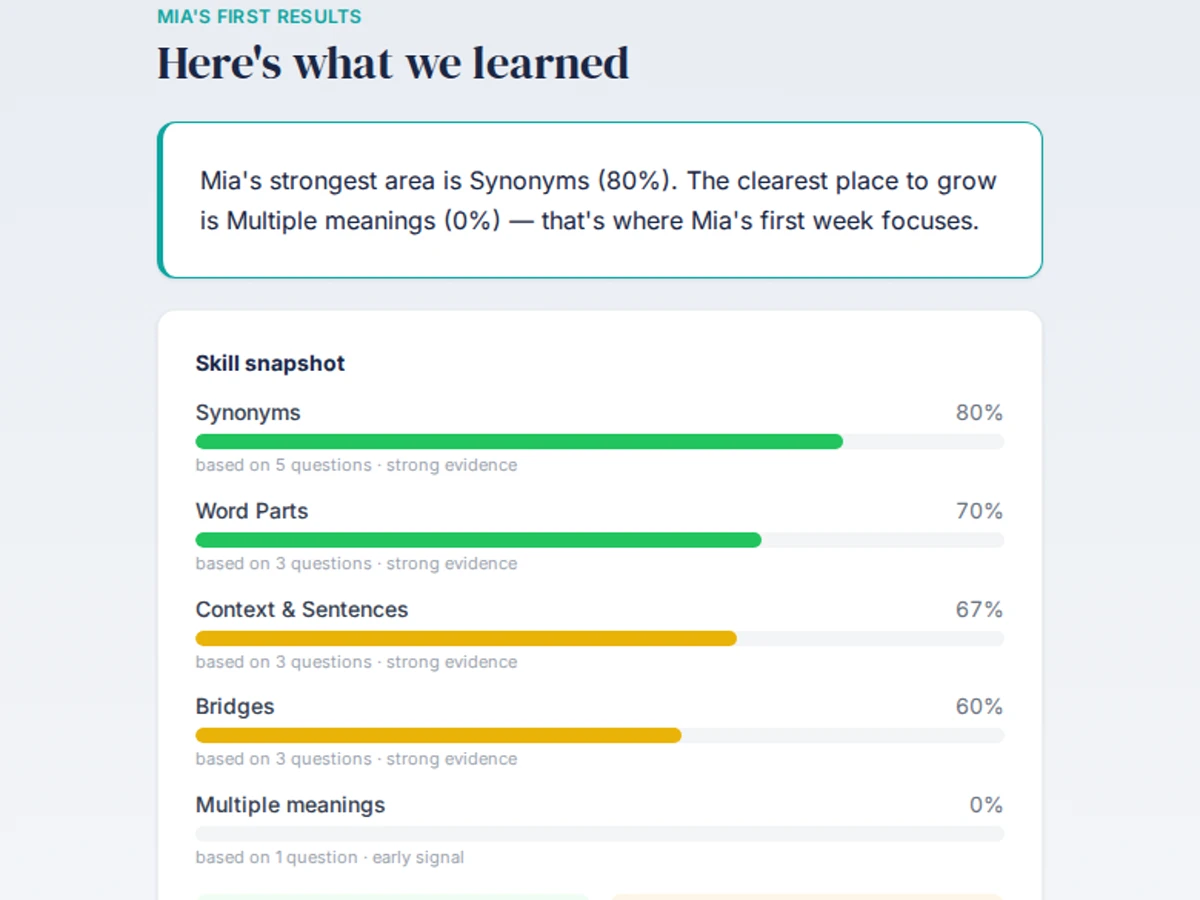
The check-up samples verbal skills and gives you an early strength, a growth area, and a first practice focus. It is not a full-length exam, an official SSAT or ISEE score, or an admissions prediction.
Catholic high school can represent exceptional educational value — rigorous academics, strong community, and a track record of college preparation, often at a fraction of the cost of comparable secular private schools. Merit scholarships based on HSPT scores can make this education even more accessible. But the scholarship landscape is fragmented, school-specific, and not widely publicized.
This guide explains how HSPT-based scholarships work, what score thresholds to aim for, and how focused verbal preparation can meaningfully move your child's score into scholarship-competitive territory.
How Catholic High School Merit Aid Works
Unlike college merit aid, which follows relatively standardized formulas across institutions, Catholic high school scholarship programs are determined entirely by individual schools. There is no central database, no standard threshold, and no requirement that schools publish their criteria publicly.
That said, consistent patterns emerge across Catholic high school scholarship programs:
Pattern 1: HSPT composite score thresholds
Most merit aid is tied to the HSPT composite standard score — the overall scaled score that combines all five sections. Schools typically establish a minimum composite threshold for scholarship consideration, and a higher threshold for specific named awards.
Pattern 2: Percentile rank bands
Many schools use percentile rank rather than raw or scaled scores, since percentile ranks are more immediately interpretable and adjust for any variation across HSPT test forms year to year. Common percentile thresholds:
- 75th–85th percentile: Eligible for basic merit consideration at many schools
- 90th–95th percentile: Competitive for partial scholarships (typically $500–$2,500/year)
- 95th–99th percentile: Competitive for full or near-full scholarships at most schools
Pattern 3: Academic profile weighting
Most Catholic high schools do not award scholarships based solely on HSPT scores. The typical scholarship consideration package includes:
- HSPT composite score (primary factor, usually 50-70% of the decision)
- Cumulative GPA from middle school (typically 7th-8th grade)
- Teacher recommendations or academic references
- Interview performance at some schools
- Community or service involvement
Pattern 4: Automatic vs. applied scholarships
Some schools automatically offer scholarships to students above a certain HSPT threshold; others require a separate scholarship application. Always contact each school's financial aid or admissions office to understand their process.
HSPT Score Ranges and What They Mean
The HSPT composite standard score ranges from approximately 200 to 800, with a national mean of approximately 500. Here is how to interpret score ranges in the scholarship context:
Below 50th Percentile (approx. below 500 composite)
Students in this range are generally admitted based on holistic review — strong GPA, recommendations, or other factors — but are typically not competitive for merit aid at most Catholic high schools. The focus for these students should be on holistic application strengthening rather than HSPT-targeted preparation.
50th–75th Percentile (approx. 500–560 composite)
This is the range of average-to-above-average performance. Students in this range are comfortably admitted to most Catholic high schools and may receive small merit aid at less competitive schools. At more selective schools, this range represents the broad middle of the admitted class.
If your child is in this range and scholarship matters: There is meaningful room to improve, and targeted HSPT preparation can often move scores 15-30+ percentile points over 10-12 weeks. The verbal section is often where students underperform relative to their potential.
75th–90th Percentile (approx. 560–610 composite)
This range is where merit aid begins to open up at most schools. Students scoring at the 80th-85th percentile nationally are strong candidates for partial scholarships ranging from a few hundred to a couple thousand dollars per year.
The scholarship ROI at this level: A $1,500/year scholarship over four years is $6,000 — a meaningful contribution. If four to six weeks of structured HSPT preparation is the margin between the 74th and 80th percentile, the return on preparation investment is substantial.
90th–95th Percentile (approx. 610–650 composite)
At this level, students become competitive for more significant merit aid. Many schools have specific scholarship tiers in this range — named scholarships or academic honors recognition with meaningful award values.
95th–99th Percentile (approx. 650+ composite)
The top 5% are competitive for the largest merit awards at most Catholic high schools. Full or near-full tuition scholarships — sometimes called Presidential, Excellence, or Founders' awards — typically require scores at this level.
At elite Catholic high schools (Regis High School in NYC, for example, offers full tuition to all admitted students; Archbishop Mitty in San Jose is fully funded by endowment), scholarship structure works differently — acceptance itself is the scholarship. Contact individual schools for their specific programs.
The Verbal Section's Outsized Importance
Here is a critical insight for families focused on scholarship scores: the verbal section is the most improvable section on the HSPT through targeted short-term preparation.
The reasons:
The HSPT verbal section rewards acquired knowledge. Unlike quantitative reasoning or spatial processing (which are more ability-dependent), vocabulary and verbal reasoning directly measure knowledge that can be systematically acquired. A student who does not know what tenacious means can learn it. A student who has not encountered the analogy bridge "tool to creation" can practice it.
Most students underprepare for verbal. The most common HSPT preparation mistake is focusing exclusively on math. Parents know their child's math grade; they can predict math performance. Verbal feels harder to prepare for. The result is that many students leave verbal section points on the table that could be captured with focused preparation.
The verbal section is 16 minutes of 60 questions. The time pressure of the HSPT verbal section (16 seconds per question) means that students who know words instantly outperform students who search their memory slowly. This speed gap is primarily a familiarity gap — it closes with practice.
How many percentile points can focused verbal preparation yield? This varies by student, but research on morphological instruction (learning through roots and affixes) shows effect sizes of d = 0.30–0.60 on vocabulary assessments (Bowers, Kirby & Deacon, 2010) — translating to meaningful real-world gains on vocabulary-dependent tests like the HSPT verbal section.
School-Specific Scholarship Information: How to Find It
Because scholarship programs are school-specific, families need to do school-by-school research. Here is how to get the information you need:
Step 1: Call the admissions office directly
Ask: "Does your school offer merit scholarships based on HSPT scores? What is the threshold for consideration? Is there a separate scholarship application?"
Many schools are reluctant to publish exact thresholds online (they do not want to create strategic testing behavior or manage expectations), but admissions staff will generally answer direct questions.
Step 2: Request a financial aid consultation
Most Catholic high schools have a financial aid office or coordinator. Schedule a brief consultation to understand the merit aid landscape before the HSPT — not after. This lets you calibrate preparation goals.
Step 3: Check the school's website
Some schools publish scholarship information on their admissions or financial aid pages. Look for language about "academic excellence awards," "merit scholarships," "Presidential Scholarship," or "Bishop's Award."
Step 4: Ask current families
Parents of current students in parish communities, school alumni networks, and local Facebook groups are often the best source of on-the-ground scholarship information, including realistic award amounts and typical score thresholds.
Preparing for Scholarship-Level HSPT Scores
If scholarship eligibility is a goal, the HSPT score target is clear: 90th percentile or above on the composite. Here is what preparation looks like:
Realistic preparation window: 10-12 weeks
For students currently scoring at the 60th-75th percentile (on diagnostic practice), a 10-12 week preparation window with consistent daily practice is a realistic path to the 85th-92nd percentile range. This is meaningful movement — it can shift a student from partial scholarship consideration to strong scholarship consideration at many schools.
Where to focus preparation effort
Verbal Section (highest ROI for most students):
- Root-word vocabulary study: 25-30 Latin/Greek roots with derived word families
- Synonym and antonym pair mastery
- Analogy bridge-type fluency (12+ bridge types)
- Verbal classification precision practice
- 5-minute timed synonym drills (4-5x/week) starting 4 weeks before the test
Mathematics (second priority):
- Identify specific math concept gaps through a diagnostic practice test
- Focus preparation on the concepts with the most questions (arithmetic operations, fractions, basic algebra, geometry)
Reading Comprehension (third priority):
- Practice active reading strategies (annotating for main idea, author's purpose, tone)
- Targeted practice on vocabulary-in-context questions
Practice test timing
Take a full-length HSPT practice test at the start of preparation to establish a baseline. Take a second practice test at the halfway point (week 5-6) to assess progress and adjust focus areas. Take a final practice test 2 weeks before the real test.
Do not take practice tests in the final week before the actual HSPT — use that week for review, sleep, and reducing anxiety.
Scholarship Preparation Is Investment Thinking
The Catholic high school parents who are most strategic about HSPT preparation typically think about it in investment terms: what is the cost of 10-12 weeks of consistent preparation, and what is the potential return?
Consider a student who is currently at the 75th percentile (no scholarship eligibility) and improves to the 88th percentile (partial scholarship eligibility at many schools). If that improvement results in a $2,000/year scholarship over four years, that is $8,000 in merit aid.
The preparation investment — primarily time, with modest costs for quality preparation materials — is small relative to the potential financial return. And unlike college merit aid (which is often tied to maintaining a GPA), most Catholic high school HSPT scholarships are awarded for the full four years without a renewal requirement.
Beyond the financial return: a student who enters Catholic high school as an identified academic achiever — with a scholarship as tangible recognition — often experiences the social and motivational benefits of that identity. Academic achievement is self-reinforcing when it is recognized and celebrated.
A Note on Test Anxiety and Scholarship Pressure
One caution for families: communicating scholarship stakes directly to your child before the HSPT can create test anxiety that undermines performance. Students who take the test knowing "we really need a scholarship score" often experience the exact cognitive performance degradation that high pressure produces.
The better frame: "We want you to do your best on this test, and the preparation we have been doing will help you do that. A strong performance opens up good options." This is accurate, low-pressure, and allows your child to bring their full cognitive capacity to test day rather than dividing it between the task and the anxiety.
Prepare with scholarship goals in mind; communicate with your child with confidence-building intent.
Vocabulary roots give your child a foothold in the verbal section — they are the on-ramp. But what pushes a score from the 75th percentile into scholarship territory is the full breadth of verbal skill your child brings on test day: vocabulary knowledge is one of five domains, alongside relational reasoning (analogy bridge fluency), contextual inference (reading signal words under time pressure), test execution habits (pacing, skip strategy, confidence), and metacognitive awareness of when to commit and when to move on. LexiMap trains all five and surfaces them on a parent dashboard so you can see where prep is paying off before the real test.
Key Takeaways
- Most Catholic high school merit aid requires a composite HSPT score at the 90th–95th percentile or above; thresholds are school-specific and should be confirmed directly with each admissions office.
- The verbal section is the highest-ROI preparation target: vocabulary and verbal reasoning are directly teachable skills, and most students underprepare for them relative to math.
- A realistic 10–12 week window of consistent daily practice can move students from the 60th–75th percentile into scholarship-competitive territory.
- Scholarship preparation involves full-composite strategy — verbal, math, and reading comprehension — with verbal as the priority for most students.
- Communicate preparation goals to your child with confidence-building language, not scholarship pressure, to protect test-day performance.
For a complete guide to the HSPT verbal section — all five question types, timing strategy, and preparation schedule — see our HSPT verbal section parent guide. For families navigating NYC and NJ Catholic school testing, see our TACHS and COOP guide.
Get SSAT/ISEE vocabulary resources by email
Related Articles
Best Vocabulary Apps for Private-School Admissions Tests (2026)
Compare vocabulary prep apps for private-school entrance exams — SSAT, ISEE, HSPT, and more. What to look for, honest tool comparisons, and how to choose for your child.
Entrance Exam Test Dates 2026-2027: Complete Calendar
Complete 2026-2027 test date calendar for SSAT, ISEE, HSPT, TACHS, COOP, and CogAT. Registration deadlines, testing windows, and score release dates in one place.
When to Start Verbal Test Prep: Month-by-Month Timelines by Exam
When to start test prep for SSAT, ISEE, HSPT, TACHS, COOP, and CogAT verbal. Month-by-month timelines so your child peaks on test day — not weeks before or after.
50 Latin Root Words Every SSAT Student Should Know
Master the 50 most important Latin root words for the SSAT. Each root includes meaning, example words, and memory tips to build lasting vocabulary skills.
Related Guides
SSAT Vocabulary: The Complete Guide to Root-Based Learning
Master SSAT vocabulary through Latin and Greek roots. Learn how root-based learning, spaced repetition, and interactive practice build lasting verbal skills for grades 4-12.
SSAT Vocabulary List: 200+ Words Organized by Level and Root
Comprehensive SSAT vocabulary word lists organized by test level (Elementary, Middle, Upper) and root word family. Study the right words for your child's grade.
SSAT® is a registered trademark of The Enrollment Management Association. ISEE® is a registered trademark of the Educational Records Bureau (ERB). LexiMap is not affiliated with or endorsed by these organizations.