HSPT Verbal Section: The Parent's Complete Guide
Find your child’s vocabulary gaps
Start with a free, no-card vocabulary check-up and get a personalized parent report.
Find the vocabulary gaps — freeSee a sample parent report before starting
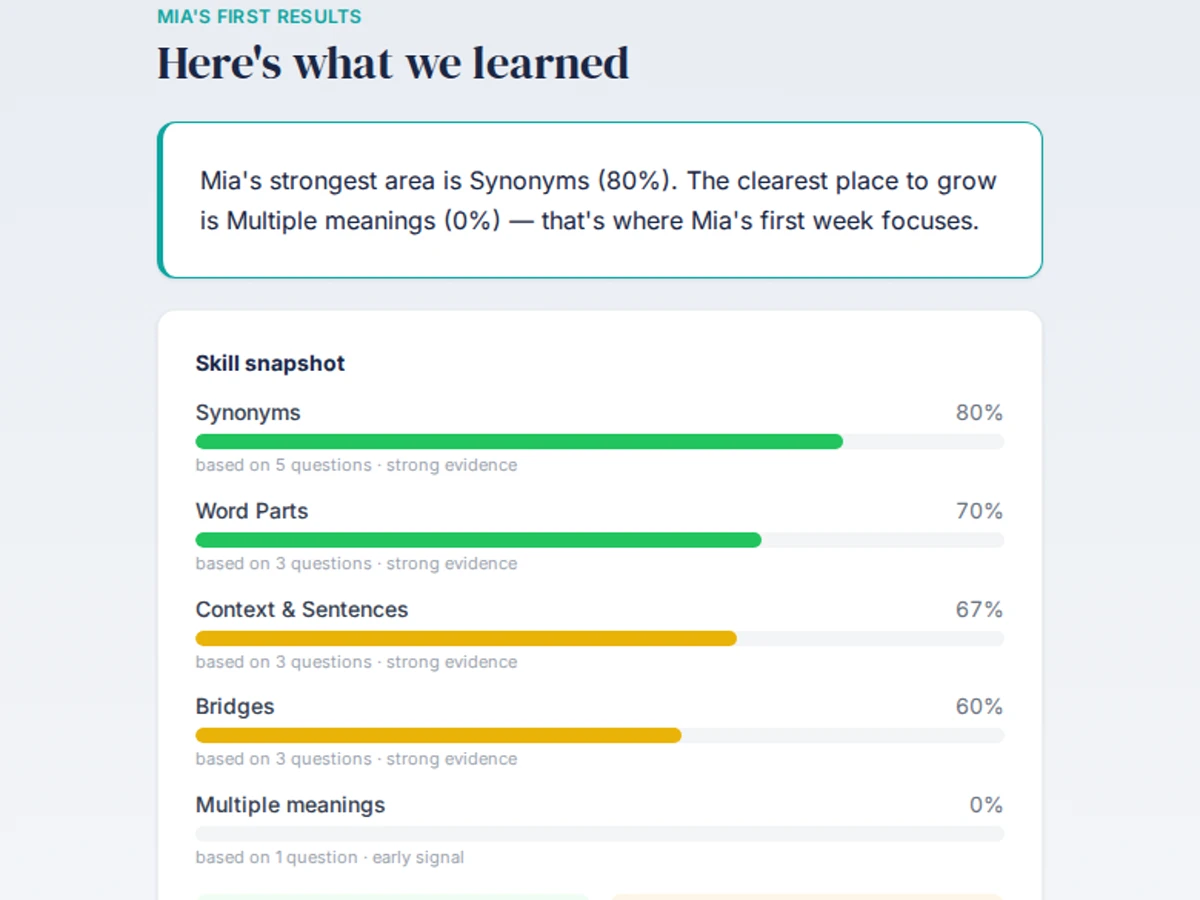
The check-up samples verbal skills and gives you an early strength, a growth area, and a first practice focus. It is not a full-length exam, an official SSAT or ISEE score, or an admissions prediction.
The High School Placement Test is the entrance exam that Catholic high school hopefuls across the country face each November and December. If your child is applying to a Catholic high school for ninth grade, the HSPT is almost certainly on the calendar — and the verbal section is where students can make up the most ground with focused preparation.
This guide covers everything parents and students need to know about the HSPT verbal section: what it tests, how it is scored, what verbal skills matter most, how to prepare strategically, and what score targets you should be aiming for if scholarship consideration is a goal.
What Is the HSPT?
The High School Placement Test is published by Scholastic Testing Service (STS) and is administered exclusively at Catholic high schools. Unlike the SSAT and ISEE, which are taken at independent testing centers, you take the HSPT at the specific school or schools you are applying to.
The HSPT tests five academic areas:
| Section | Questions | Time |
|---|---|---|
| Verbal Skills | 60 questions | 16 minutes |
| Quantitative Skills | 52 questions | 30 minutes |
| Reading | 62 questions | 25 minutes |
| Mathematics | 64 questions | 45 minutes |
| Language Skills | 60 questions | 25 minutes |
The Verbal Skills section is the shortest section in time (16 minutes for 60 questions) but contains some of the most vocabulary-intensive questions on the test. We will focus on this section, though we will also note the Language Skills section, which tests grammar and sentence-level skills.
The HSPT Verbal Skills Section: Five Question Types
The Verbal Skills section contains five distinct question types, each requiring a different cognitive skill. Understanding all five is essential for targeted preparation.
1. Synonyms (approximately 15 questions)
A single word is presented and you choose the answer closest in meaning. This is identical in format to the SSAT synonym section.
Example: TENACIOUS means most nearly: (A) brave (B) persistent (C) generous (D) timid
What to study: Precise vocabulary ownership. A student who knows tenacious means "holding firmly to a purpose or position" can immediately distinguish it from brave (which involves fearlessness, not persistence). Root knowledge helps: tenac- comes from Latin tenere (to hold) — the same root as retain, contain, abstain.
2. Antonyms (approximately 15 questions)
Given a word, choose its opposite. This tests the same vocabulary as synonyms but requires knowing the word's meaning precisely enough to identify its contrast.
Example: BENEVOLENT means the opposite of: (A) kind (B) malevolent (C) wealthy (D) indifferent
What to study: Vocabulary alongside its antonym pairs. The prefix bene- (good) and mal- (bad) are natural antonym generators — benevolent/malevolent, benefactor/malefactor, benign/malign. Learning words in prefix-based antonym pairs is twice as efficient as learning them individually.
3. Analogies (approximately 12 questions)
A:B :: C:? format — identify the relationship between the first pair and apply it to find the fourth term. The HSPT uses the same bridge types as the SSAT and CogAT.
Example: Brush is to painting as pen is to: (A) writing (B) desk (C) school (D) art
What to study: Bridge type fluency. This example is a "tool to creation" bridge: a brush is the tool used to create a painting; a pen is the tool used to create writing. Students who can name bridge types instantly answer correctly; students who reason laboriously through each pair run out of time on a 16-minute section.
4. Verbal Logic (approximately 8 questions)
These are classification-based logic questions. Given a set of conditions, students identify what must be true, what might be true, or what cannot be true.
Example: All dogs are animals. All animals need food. Therefore: (A) All animals are dogs. (B) All dogs need food. (C) Some food is for dogs. (D) Dogs are the only animals.
What to study: The three classic logical relationships — all A are B, some A are B, no A are B — and which conclusions they do and do not permit. Students who confuse "all A are B" with "all B are A" (the converse fallacy) make predictable errors. Brief practice with syllogism structures makes this question type very manageable.
5. Verbal Classification (approximately 10 questions)
Three words that share a category; choose the fourth word that belongs.
Example: Which word does NOT belong? (A) oak (B) maple (C) birch (D) eucalyptus ... wait, they all belong to "trees" — but a harder version: (A) oak (B) pine (C) birch (D) walnut
What to study: Precise category membership. At the easy level, students identify the obvious outlier. At the harder level, three of the four words belong to a specific sub-category and the task requires fine-grained semantic precision. Oak, birch, and walnut are all deciduous trees; pine is an evergreen. Students who think in loose categories ("they're all trees") miss these.
HSPT Verbal Scoring
Standard HSPT Scores
The HSPT reports several score types:
- Raw score: Number correct (no penalty for wrong answers)
- Standard score: Scaled score (range approximately 200-800) comparing performance to the national norm group
- Percentile rank: Compared to all students who have taken the HSPT
- Cognitive skills quotient (CSQ): IQ-like composite score across Verbal and Quantitative sections
For the Verbal Skills section specifically:
- Average (50th percentile): approximately standard score 500
- 75th percentile: approximately standard score 560-570
- 90th percentile: approximately standard score 600-620
- 99th percentile: approximately standard score 700+
HSPT and Scholarship Eligibility
This is the section most relevant for families considering Catholic high school merit aid. Scholarship thresholds vary significantly by school, but general patterns:
Admissions-only scores (no scholarship consideration): 50th–70th percentile; students are admitted but not competitive for merit aid
Merit aid eligibility: 75th–85th percentile overall; many schools have scholarship programs that begin at this range
Significant merit aid (partial scholarships): 90th–95th percentile overall; competitive for named scholarships at most Catholic high schools
Full scholarship consideration: 95th–99th percentile overall; rare, competitive for highest-prestige awards
For detailed scholarship score breakdowns, see our HSPT scholarship scores guide.
Important nuance: Scholarship decisions are typically based on the HSPT composite score (all five sections combined), not verbal alone. However, the verbal section is among the most improvable with targeted preparation — making it a high-leverage area for students who want to boost their overall composite.
HSPT Verbal Prep: A Strategic Approach
The Time Pressure Challenge
The most distinctive feature of the HSPT Verbal Skills section is its time pressure: 60 questions in 16 minutes. That is 16 seconds per question. This is dramatically faster than any other entrance exam verbal section.
At 16 seconds per question, students cannot deliberate. The answers to synonym and antonym questions must be near-instant — either a student knows the word or they do not. Analogy questions require immediate bridge identification. Verbal logic requires applying a familiar logical structure.
This time pressure has important implications for preparation:
- Vocabulary must be owned, not just recognized. Flashcard familiarity is insufficient — students need to be able to recall precise meanings instantly.
- Bridge types must be automatic. Students who have to think hard about what kind of relationship is being tested will run out of time.
- Answer confidently on known items; skip instantly on unknowns. With no wrong-answer penalty, time spent agonizing over unknowns is always better spent on items you can answer.
Preparation Timeline
10-12 weeks is ideal for HSPT verbal preparation. This allows:
- 4-6 weeks to build root-word and vocabulary foundation
- 2-3 weeks to add antonym pair study and verbal logic practice
- 2-3 weeks of timed practice to build speed
8 weeks is workable if your child has a strong existing vocabulary base and is primarily building test familiarity and speed.
Less than 6 weeks should focus on format familiarity and existing vocabulary consolidation rather than new vocabulary acquisition (new words need time to consolidate in long-term memory).
Priority Sequence: What to Study First
Given the 5-question-type structure of the HSPT verbal section, here is the recommended preparation priority order:
Priority 1: Synonyms and antonyms (most questions, most directly testable)
- Study Latin and Greek roots organized by word families
- Learn vocabulary in bene-/mal- antonym pairs
- Study synonym clusters with nuance (happy/elated/euphoric/ecstatic)
- Use spaced repetition to consolidate vocabulary over weeks, not days
Priority 2: Analogies (bridge-type fluency)
- Learn and practice all 12+ standard bridge types
- Practice naming the bridge before attempting to answer
- Work through varied bridge types each session to build flexibility
Priority 3: Verbal classification (category precision)
- Practice with "odd one out" exercises at increasing difficulty
- Focus on the distinction between broad categories and precise sub-categories
- Study word families as natural classification practice
Priority 4: Verbal logic (logical structure recognition)
- Study the three syllogism forms (all/some/no)
- Practice valid vs. invalid conclusion identification
- This question type responds quickly to even a brief study focus
Recommended Study Schedule (10 Weeks)
Weeks 1-4 (Foundation):
- Daily: 15 min root/vocabulary study (2-3 roots per day)
- Daily: 10 min synonym/antonym practice (10 questions)
- Weekly: 2 analogy sets (20 questions each, name the bridge)
- Weekly: 1 classification set (10 questions, explain category)
Weeks 5-7 (Development):
- Daily: 10 min synonym/antonym review (spaced repetition)
- Daily: 10 min analogy practice (mixed bridge types)
- Weekly: verbal logic review session (15-20 minutes)
- Weekly: full 60-question timed practice section (under 16 minutes)
Weeks 8-10 (Test-Ready):
- Daily: 15 min mixed verbal practice (timed, all five types)
- Weekly: two full timed verbal sections
- Focus: review wrong answers for root/bridge/category patterns
- Week 10: final review; no new material; focus on sleep and confidence
HSPT vs. SSAT vs. ISEE Verbal: Key Differences
| Feature | HSPT | SSAT | ISEE |
|---|---|---|---|
| Time per question | 16 seconds | 30 seconds | ~30 seconds |
| Question types | Synonyms, antonyms, analogies, verbal logic, classification | Synonyms, analogies | Synonyms, sentence completion |
| Wrong-answer penalty | None | -¼ point | None |
| Vocabulary depth required | High | High | Moderate-high |
| Unique to this test | Antonyms + verbal logic | — | Sentence completion |
| Prep transferability | High (all skills transfer to SSAT/ISEE) | High | High |
The biggest HSPT-specific element is antonyms (the SSAT and ISEE do not test antonyms explicitly) and verbal logic (syllogism-based reasoning). Budget specific practice time for both.
Building a Vocabulary Curriculum for HSPT Verbal
The most efficient HSPT verbal vocabulary curriculum has three layers:
Layer 1: Root families (weeks 1-4) Learn 25-30 high-frequency Latin and Greek roots. See our SSAT word list by root families — it transfers directly to HSPT preparation.
Layer 2: Prefix-based antonym pairs (weeks 3-6) Build vocabulary around the most common antonym-generating prefixes:
- bene-/mal-: benevolent/malevolent, benefactor/malefactor, benign/malign
- pro-/anti-: progress/regress, promote/demote
- in-/out- or in-/ex-: include/exclude, internal/external
- over-/under-: overlook/underestimate, overstate/understate
Layer 3: Precision clusters (weeks 5-8) Study synonym clusters with nuance. For the HSPT, common clusters include:
Stubborn: obstinate, obdurate, tenacious, pertinacious, dogged, recalcitrant (escalating from mild to extreme stubbornness)
Clever: astute, shrewd, sagacious, perspicacious, discerning (different types of intellectual sharpness)
Poor/inadequate: meager, paltry, scanty, sparse, deficient (different shades of insufficiency)
Brave: courageous, intrepid, valiant, dauntless, audacious (different qualities of bravery)
Test Day Logistics
Where is the test taken? At the Catholic high school you are applying to. If you are applying to multiple schools, you may take the HSPT at each one — but check with each school whether they accept score transfers or require you to test on-site.
What to bring: Photo ID (student ID or school ID), pencils, and any materials the school specifies. Most schools provide pencils; bring extras anyway.
Test day morning: Eat a protein-rich breakfast; avoid sugar. Arrive 10-15 minutes early to settle in. The test takes approximately 2.5-3 hours with brief breaks between sections.
Scoring and results: Most Catholic high schools release HSPT scores in December or January. Admissions decisions and scholarship notifications typically follow within a few weeks of score release.
The root-and-affix curriculum described above is a strong on-ramp, but scholarship-level performance comes from owning all five verbal skill domains your child will draw on under that 16-second-per-question clock. Vocabulary knowledge is one; relational reasoning (bridge-type fluency on analogies), contextual inference (reading signal words in sentence completion), test execution (skip strategy, time awareness, staying confident on hard items), and metacognition (knowing when to commit vs. move on) are the other four. LexiMap builds and tracks all five domains, and shows where your child stands on each in the parent dashboard — so you know what to reinforce with six weeks to go.
Key Takeaways
- The HSPT Verbal Skills section is 60 questions in 16 minutes — the fastest-paced verbal section on any secondary school entrance exam, requiring instant vocabulary recall and automatic bridge-type recognition.
- Five question types require distinct preparation: synonyms and antonyms reward root-based vocabulary; analogies reward bridge-type fluency; verbal classification rewards precision category thinking; verbal logic responds quickly to syllogism structure practice.
- A 10–12 week preparation window allows for vocabulary foundation-building, antonym pair study, timed speed practice, and practice test calibration.
- The verbal section is the most improvable section on the HSPT through targeted short-term prep — most families underprepare for it and leave scholarship-relevant points on the table.
- Scholarship decisions use the composite score across all five sections; verbal improvement raises the composite most efficiently for most students.
LexiMap's verbal training covers all five HSPT verbal question types with adaptive practice sessions. Build the vocabulary ownership and bridge-type fluency the HSPT's 16-second-per-question pace demands. Learn more about HSPT prep.
Get SSAT/ISEE vocabulary resources by email
Related Articles
SSAT Verbal Study Strategies: Your 3-Month Plan
A research-backed 3-month SSAT verbal study plan covering synonyms, analogies, and vocabulary. Week-by-week schedule for Middle and Upper Level students.
ISEE Analogy Practice: How Relationship Thinking Helps with Synonyms & Sentence Completions
The ISEE doesn't test analogies — but analogy thinking is the key to ISEE synonyms and sentence completions. Learn bridge types, practice questions, and root word strategies.
Beyond Analogies: Relational Reasoning Across the Whole Verbal Section
Analogies, synonyms, antonyms, and word families all test one skill: relational reasoning. How to develop the relationship-thinking that lifts your child's whole verbal score.
Best Vocabulary Apps for Private-School Admissions Tests (2026)
Compare vocabulary prep apps for private-school entrance exams — SSAT, ISEE, HSPT, and more. What to look for, honest tool comparisons, and how to choose for your child.
Related Guides
SSAT Vocabulary: The Complete Guide to Root-Based Learning
Master SSAT vocabulary through Latin and Greek roots. Learn how root-based learning, spaced repetition, and interactive practice build lasting verbal skills for grades 4-12.
SSAT Vocabulary List: 200+ Words Organized by Level and Root
Comprehensive SSAT vocabulary word lists organized by test level (Elementary, Middle, Upper) and root word family. Study the right words for your child's grade.
SSAT® is a registered trademark of The Enrollment Management Association. ISEE® is a registered trademark of the Educational Records Bureau (ERB). LexiMap is not affiliated with or endorsed by these organizations.