Signal Words: The Little Words That Solve Sentence Completions
Find your child’s vocabulary gaps
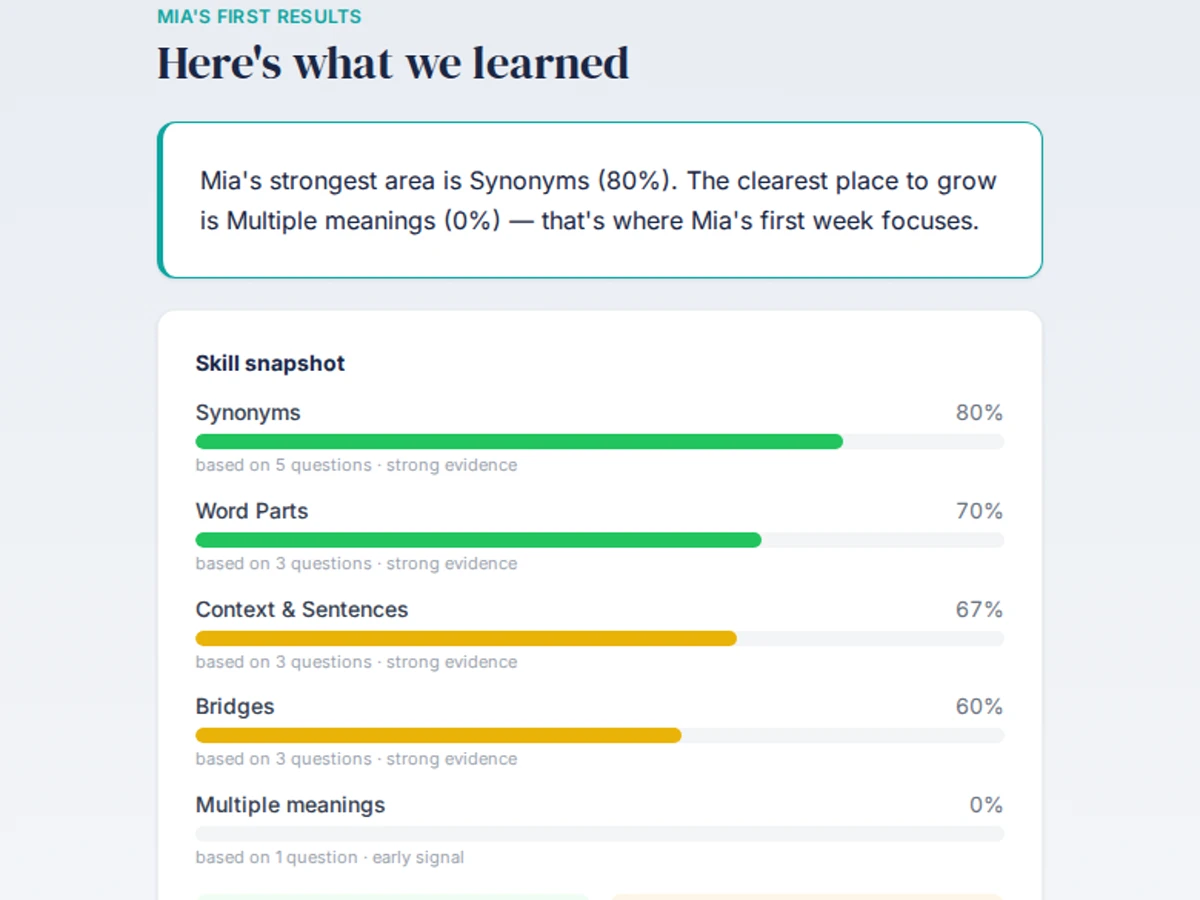
Start with a free, no-card vocabulary check-up and get a personalized parent report.
Find the vocabulary gaps — freeSee a sample parent report before starting
The check-up samples verbal skills and gives you an early strength, a growth area, and a first practice focus. It is not a full-length exam, an official SSAT or ISEE score, or an admissions prediction.
Your child reads a sentence completion twice, carefully, and still picks the wrong answer. The vocabulary was not the problem — they knew the words in the choices. The reasoning was not the problem — they can explain the sentence perfectly. So what went wrong? Almost always, it is a small word they skimmed past: "however," "despite," "although." A word that takes up almost no space on the page but carries the entire logical weight of the sentence. They missed the signal, and the signal was the answer.
Signal words are the steering mechanism of written language. They tell a reader whether the idea ahead continues the same direction or reverses it, whether one thing causes another, whether what follows is an example or a conclusion. In ordinary reading, your child can miss these words and still track the meaning by feel. In sentence completions, there is no "by feel" — the signal word is often the only piece of information that determines which of five answer choices is right. Getting it right starts with seeing it at all.
This post is a focused, drill-ready guide to signal words for parents coaching a child through SSAT, ISEE, or any verbal reasoning test. These are short sessions, specific targets, and the kind of practice that transfers quickly to real questions.
The words your child skims past (and shouldn't)
English is full of tiny words that carry enormous logical freight. "However." "Because." "Despite." "Although." "Therefore." "Moreover." Your child has been reading these words since second grade, which is precisely the problem — they are so familiar that the eye slides right over them. On a sentence completion, that slide costs a point.
Here is a quick illustration. Consider two sentences that are otherwise identical:
"The council's proposal was bold, and the mayor __________ it."
"The council's proposal was bold, but the mayor __________ it."
In the first sentence, the blank likely needs a positive word — approved, endorsed, championed. In the second, a negative one — rejected, dismissed, opposed. The entire meaning of the blank swings on a single three-letter word. A child who reads "bold" and starts scanning the choices has already missed the information that decides the question.
Signal words are not background noise. They are the most load-bearing words in a sentence completion — more reliable than any single piece of vocabulary, because they dictate the relationship between the parts of the sentence rather than merely adding to its content. Teaching your child to see them is less about vocabulary and more about training a new reading habit: slow down on the small words, because those are the ones doing the real work.
Continuation signals: "and, moreover, because" (same direction)
The first family of signal words keeps a sentence moving in the same direction. These are the words that say: what comes after me agrees with what came before me, extends it, or explains it. The blank, when these words are present, should match the tone and direction of the surrounding sentence.
Common continuation signals: and, also, moreover, furthermore, additionally, because, since, therefore, thus, consequently, so, as a result, in fact, indeed, similarly, likewise, for example, for instance, such as.
The mental cue is: same direction. If the sentence is moving positively and hits a continuation signal, the blank stays positive. If the tone is critical and a "moreover" appears, the blank should be critical too. "Moreover" is especially powerful — it means "and here's more of the same, amplified." A child who sees "moreover" and expects continuation will never be surprised.
"Because" and "since" are the cause-and-effect continuation signals — they don't just say "same direction," they say "this explains that." The blank either becomes the cause of what's described or the effect of it. Either way, the direction is coordinated, not reversed.
A simple home drill: read any sentence containing one of these words, have your child identify the signal, and ask "same direction or opposite?" The correct answer for every word on this list is "same direction." Ten such sentences in a sitting, and the habit starts to form.
Contrast signals: "but, however, despite, although" (reverse direction)
The second family is the one that catches the most students — and the one that rewards the most training. Contrast signals tell your child that the sentence is about to turn. What comes after will oppose, limit, or contradict what came before. If the sentence has been positive, the blank goes negative. If the setup is negative, the blank reverses to something neutral or positive.
Common contrast signals: but, however, yet, although, though, even though, while, whereas, despite, in spite of, nevertheless, nonetheless, on the other hand, unlike, rather, instead.
"Despite" and "in spite of" are worth special attention because they are high-frequency on SSAT and ISEE and they reverse the entire meaning of what follows: "Despite her __________ reputation, she gave a compelling performance." The reputation must be bad — the word "despite" guarantees the performance was good, so the reputation that the "despite" is overriding must be the opposite. Students who miss "despite" choose a positive word for reputation and pick a wrong answer that feels completely logical.
"Although" and "even though" behave the same way. They introduce the part of the sentence that loses — the idea that gets overridden. "Although the team played well, they __________" means the blank will be something negative (lost, struggled, fell short), because the word "although" flagged the first clause as the thing that didn't carry the day.
The drill for contrast signals is the same structure but with the opposite rule: whenever your child sees one of these words, the answer direction flips. Positive setup → negative blank. Negative setup → positive blank. That's the whole rule, and five minutes of repeating it on varied sentences makes it automatic.
Cause/effect and example signals
Two smaller but still useful families round out the signal-word catalog.
Cause/effect signals (because, since, therefore, thus, as a result, so) establish a logical dependency between parts of a sentence. The blank is either the cause of what's described or the effect of it. The key coaching point: once your child identifies which role the blank is playing, they can predict the blank's relationship to the other clause precisely. "The drought was severe, so crops __________" — the effect of a severe drought on crops is negative, and the blank should reflect that.
Example signals (for example, such as, for instance, including, like) introduce a specific instance of a broader claim. If the blank is the general statement and the examples are given, the blank should be broader and more abstract than the examples. If the examples appear first and the blank is the generalization, it should be a label that covers all of them. These appear less often in sentence completions than in reading comprehension, but recognizing them keeps your child from being confused by the structure of the sentence.
A useful exercise: collect a dozen sentences — from practice tests, from your child's reading, from a newspaper — and have your child circle signal words and label them: continuation, contrast, cause-effect, or example. The labeling step slows down the eye and builds the habit of noticing the signal before moving to the blank.
Two-blank sentences: when signals govern both blanks
Double-blank sentence completions add a layer of complexity, and signal words are the fastest way to cut through it. The relationship between the two blanks is almost always determined by a signal word — and once your child identifies that signal, half the answer choices disappear immediately.
The key question is: do the two blanks point the same direction or opposite directions? A continuation signal between two blanks means both are positive, or both negative, or both neutral. A contrast signal means one is positive and the other is negative. That judgment alone eliminates most wrong-answer pairs.
Consider: "She was known for her __________, and her colleagues often praised her __________." The "and" is a continuation signal — the second blank should match the first. Both are positive. Eliminate every pair where one word is negative or where the charges conflict, and the answer space collapses fast.
Now flip it: "Although he claimed to be __________, his behavior revealed him to be genuinely __________." The "although" signals reversal. The first blank and the second must oppose each other in charge or direction. Any pair where both words are positive or both are negative is wrong. Your child can eliminate those pairs without even reading the words carefully — the signal has already done the work.
Teach this as a two-step reflex: (1) find the signal word, (2) decide whether the blanks agree or oppose. Only then start evaluating the actual vocabulary in the answer choices. This order — signal first, words second — is the fastest path through the hardest question type on the verbal section.
A 10-minute signal-word drill for home (and the dashboard's Contextual Inference signal)
Signal-word fluency is one of the fastest verbal skills to build, because it is almost entirely about habit — seeing the word, reading its family, flipping or continuing accordingly. Ten focused minutes, done consistently, produces noticeable improvement within two to three weeks.
Here is a simple structure for a home session.
Minutes 1–3: Labeling run. Pull five sentences from a practice test or a reading passage. Have your child circle every signal word and label it (continuation, contrast, cause-effect, example). No blanks yet — just finding and naming the signals. Speed matters less than accuracy at this stage.
Minutes 4–7: Direction call. Add blanks to the same or new sentences. Before predicting any word, your child calls the direction for the blank: "same as what came before" or "opposite of what came before." One word: same or opposite. Then they predict a word that fits that direction. Then — and only then — they uncover the answer choices. This sequence locks in the habit of letting the signal govern the prediction.
Minutes 8–10: Two-blank rapid sort. Give two or three double-blank sentences. Your child's only job in this phase is to identify the signal and sort answer-choice pairs into "agree pairs" (both blanks same direction) and "oppose pairs" (blanks in opposite directions), then keep only the type the signal demands. They do not need to pick the final answer — just sort. This builds the elimination reflex that makes two-blank questions manageable.
This practice feeds directly into LexiMap's Contextual Inference domain — one of the five verbal domains the platform trains alongside Vocabulary Knowledge, Relational Reasoning, Test Execution, and Metacognition. The parent process-skills dashboard gives you a live view of your child's Contextual Inference signal: whether they are reading context actively, whether the signal-word habit is forming, whether they are predicting before scanning choices. It organizes those behavioral markers into three views — Test Execution Skills, Learning Skills, and Behavioral Skills — so you can see the underlying habits, not just a score. All plans start with a 7-day free trial, so you can see your child's Contextual Inference signal before committing. A child who builds the signal-word habit in ten-minute home sessions and confirms it on the dashboard has a coachable, visible edge that shows up directly on test day.
The signal words have always been there. Your child just needs to stop sliding past them.
Key Takeaways
- Signal words set a sentence's direction — agree or oppose.
- Continuation vs. contrast is the core distinction to teach first.
- Contrast signals reverse the predicted answer and catch the most students.
- Signals coordinate the two blanks in a double-blank question.
- Short, focused signal-word drills transfer quickly to real questions.
Further reading:
- Context Clues & Sentence Completion Craft
- ISEE Reading Comprehension & Vocabulary
- ISEE Verbal Strategies by Level
Get SSAT/ISEE vocabulary resources by email
Related Articles
Context Clues and Sentence Completion: The Craft of Reasoning to Meaning
Sentence completions reward reasoning, not just recall. How to teach your child to read context clues, weigh word charge, and solve completion questions with confidence.
ISEE Verbal Reasoning Strategies by Level: Primary Through Upper
Level-by-level ISEE verbal strategies for Primary through Upper Level. Vocabulary, sentence completion, and reading comprehension prep tailored to each grade band.
50 Latin Root Words Every SSAT Student Should Know
Master the 50 most important Latin root words for the SSAT. Each root includes meaning, example words, and memory tips to build lasting vocabulary skills.
8 Ways a Strong Vocabulary Shapes Your Child's Future
Beyond test scores: the eight domains of adult life — from health and wealth to careers and emotional wellbeing — where research shows vocabulary makes a measurable difference.
Related Guides
ISEE Vocabulary: The Complete Guide to Root-Based Learning
Prepare for Lower, Middle, and Upper Level ISEE verbal reasoning with word roots, sentence-completion strategies, official exam-format sources, and a practical study plan.
SSAT Vocabulary: The Complete Guide to Root-Based Learning
Master SSAT vocabulary through Latin and Greek roots. Learn how root-based learning, spaced repetition, and interactive practice build lasting verbal skills for grades 4-12.
SSAT® is a registered trademark of The Enrollment Management Association. ISEE® is a registered trademark of the Educational Records Bureau (ERB). LexiMap is not affiliated with or endorsed by these organizations.