Context Clues and Sentence Completion: The Craft of Reasoning to Meaning
Find your child’s vocabulary gaps
Start with a free, no-card vocabulary check-up and get a personalized parent report.
Find the vocabulary gaps — freeSee a sample parent report before starting
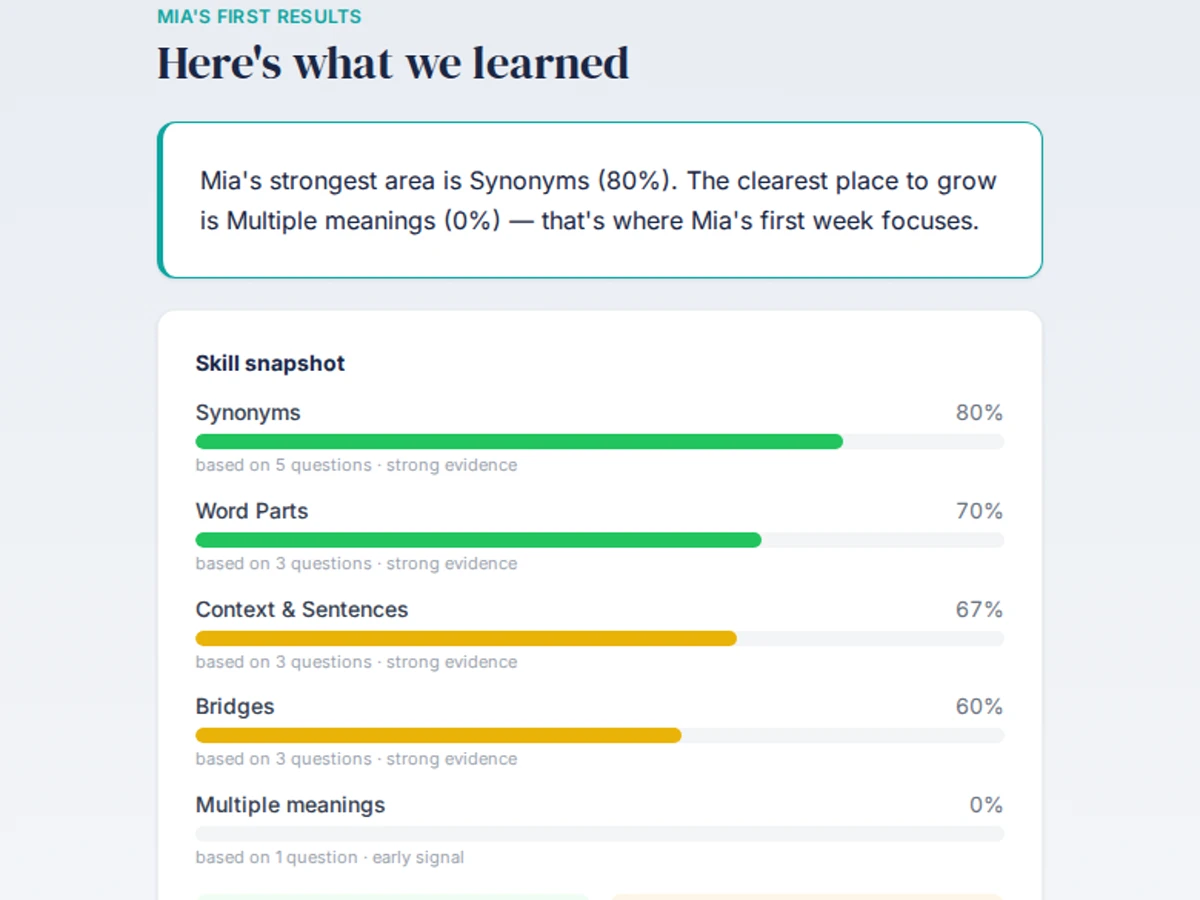
The check-up samples verbal skills and gives you an early strength, a growth area, and a first practice focus. It is not a full-length exam, an official SSAT or ISEE score, or an admissions prediction.
Your child knows the word "frugal." You quizzed them on it last week, and they got it right. Then they sit down with an ISEE sentence completion, read the sentence three times, stare at five answer choices that all look plausible, and pick the wrong one. You are left wondering how a child who knows the vocabulary can still miss the question.
Here is what most prep misses: sentence completions are not vocabulary questions wearing a costume. They are reasoning questions. The blank is not asking "do you know this word?" — it is asking "can you figure out what kind of word belongs here, based on everything the sentence is telling you?" A child can know all five answer choices and still pick wrong, because the skill being tested is not recall. It is inference from context.
This post is about the craft of that inference — the specific, teachable mental moves that turn sentence completions from a guessing game into a solvable puzzle. Sentence completions are the heart of the ISEE Verbal Reasoning section, and they reward a way of thinking that a flashcard deck never builds.
Why some questions hand your child a clue (and most prep ignores it)
There is a quiet generosity built into sentence completions that most preparation overlooks entirely. The sentence gives your child the answer — or at least the shape of the answer — before they ever look at the choices. The context is not decoration around a vocabulary word. It is a set of instructions for what the missing word has to do.
Consider this: "Despite the team's __________ start, they rallied in the second half and won decisively." Your child does not need to have memorized any particular word to know that the blank means something like poor or weak or discouraging. The word "Despite," paired with a comeback and a decisive win, tells them the start must have been the opposite of good. The sentence has handed them the meaning. All they have to do is read it.
Most prep programs treat sentence completions as a vocabulary checkpoint: did your child memorize enough words? So the advice becomes "learn more words." That is not wrong — a larger vocabulary always helps — but it misses the leverage. The leverage is teaching your child to mine the sentence for what it is telling them, because the sentence almost always tells them more than they realize. A child who reads context actively can often solve a completion even when they are shaky on the exact word, and a child who reads passively can miss one even when they know every option.
This is a different domain of verbal skill than vocabulary knowledge. At LexiMap we call it Contextual Inference — deriving meaning from surroundings rather than from memory — and it is one of five distinct verbal domains the program trains. The others are Vocabulary Knowledge (where root learning lives), Relational Reasoning (analogies and how words connect), Test Execution (pacing, elimination, guessing discipline), and Metacognition (managing one's own thinking under pressure). Roots are the on-ramp; the breadth across all five is what actually moves a score. Contextual inference is the domain this post lives in, and sentence completions are where it is tested most directly.
Sentence completion vs. synonyms: a different mental move
The ISEE Verbal Reasoning section has two question types, and they ask your child to do genuinely different things. Understanding the difference is the first step in coaching either one well.
Synonym questions are recognition. The prompt gives a word in isolation — "VERBOSE" — and asks for the closest match among five choices. There is no context, no sentence, nothing to reason from. Your child either has the word stored, can decode it from its roots, or is guessing. The mental move is retrieval: reach into memory and find the meaning.
Sentence completions are reconstruction. The word your child needs is missing, and the sentence around it defines the gap. The mental move is not "what does this word mean?" but "what kind of word would make this sentence make sense?" Your child builds a target meaning from the context first, and only then matches it to a choice. It is closer to solving a logic problem than to taking a vocabulary quiz.
This distinction matters for how you coach. A child who is strong at synonyms is not automatically strong at completions, because completions add a reasoning layer on top of word knowledge. And a child who struggles with synonyms — who has a smaller vocabulary — can still do surprisingly well on completions, because the context gives them something to work with that the bare synonym prompt does not. The two question types draw on overlapping but distinct skills, and the completion skill is the one most parents have never been shown how to teach.
The good news: the completion move is learnable, and it rests on a single habit that changes everything.
Predict before you peek: generating your own answer first
If you teach your child one thing about sentence completions, teach them this: cover the answer choices, read the sentence, and say out loud what word should go in the blank — before looking at a single option.
This one habit, predict-then-match, is the difference between solving the question and getting talked out of the right answer. Here is why it works. The test writers do not fill the wrong answers with random words. They engineer distractors — choices designed to look right to a child who is reading loosely. Some distractors are the opposite of the correct answer (and feel relevant because they are about the same topic). Some are words your child half-recognizes and grabs out of relief. Some fit the grammar of the sentence but not its meaning. When your child reads the choices first, these traps do their job: they pull attention, plant doubt, and make the loosest-fitting word feel plausible.
When your child predicts first, the traps lose their grip. Your child has already committed to a meaning — "the blank means something like stubborn" — so when they uncover the choices, they are no longer asking "which of these could work?" They are asking "which of these matches the word I already came up with?" That is a far easier and far more reliable question. The prediction does not have to be the exact answer word. It just has to capture the meaning and direction, and that is enough to recognize the right choice and dismiss the impostors.
You can practice this at the kitchen table without any test materials. Take any sentence from a book your child is reading, blank out one meaningful word, and ask them to predict it before you reveal the original. They will be right more often than they expect — which is exactly the point. The sentence carries the meaning; prediction is how your child learns to hear it. When you do use real practice questions, the rule is strict: predict first, always, even when the answer feels obvious. The obvious ones are sometimes the traps.
The anatomy of a sentence completion (one-blank and two-blank)
Once your child is predicting, it helps to understand the two structures they will face, because each has its own rhythm.
One-blank completions are the more common form. A single word is missing, and the rest of the sentence is the clue. The process is the one we have built: read the whole sentence, identify what the surrounding words demand, predict a meaning, then match. The key coaching point is to read to the end of the sentence before predicting. The decisive clue often comes after the blank, not before it. In "The normally __________ professor surprised everyone by laughing at the joke," the word "surprised" and the laughing come after the blank — and they tell you the professor is usually serious or stern. A child who predicts from the first half alone may guess wrong; a child who reads the whole sentence gets it.
Two-blank completions ask your child to fill two gaps, and the trick is that the blanks relate to each other. The correct answer is the pair that fits both slots and respects the relationship the sentence sets up. The most powerful technique here is to solve one blank at a time and eliminate aggressively. If your child can confidently rule out the first word of a pair, the whole answer choice is gone — they do not even need to evaluate the second word. This cuts a hard five-choice problem down quickly. Teach them to find whichever blank is easier, predict it, eliminate every pair whose word for that blank does not fit, and only then weigh the survivors on the second blank.
Two-blank questions also reward attention to whether the two blanks point the same direction or opposite directions — which is where signal words come in, a few sentences from now. For both structures, the underlying discipline is identical: let the sentence define the gap, predict, and eliminate. The structure changes the bookkeeping, not the thinking.
Reading word charge: positive, negative, neutral
Here is a technique that solves more completions than almost any amount of vocabulary memorization: word charge. Before worrying about a word's exact meaning, your child decides whether the blank needs a positive word, a negative word, or a neutral one. That single judgment often eliminates most of the answer choices.
Charge is the emotional or evaluative direction of a word. "Generous," "admire," and "thrive" carry positive charge. "Stingy," "scorn," and "wither" carry negative charge. "Measure," "located," and "annual" are roughly neutral. Sentences broadcast the charge they need. "The critic __________ the film, calling it a masterpiece" demands a positive word — your child can cross off every negative choice instantly, before even thinking hard about precise definitions. "The senator's __________ remarks alienated even her allies" demands a negative word. The charge is in the sentence; your child just has to feel it.
Why this is so powerful: charge lets your child make progress on words they do not fully know. Suppose the answer choices include "lauded," "censured," "amended," "ignored," and "rebuffed." A child unsure of every one of these can still reason: the sentence needs a positive word (it called the film a masterpiece), so the answer is the positive one. Even if they cannot define "lauded" precisely, they can recognize it does not feel negative the way "censured" or "rebuffed" do — and they can land on it. Charge turns "I don't know these words" into "I know which direction I need," and direction is often enough.
Practice charge as a quick game. Say a word; your child gives a thumbs-up, thumbs-down, or flat hand for neutral. Then graduate to sentences: read one with a blank and ask only "does the blank want a good word or a bad word?" before any prediction. Layering charge underneath prediction gives your child two filters working together — and most completions cannot survive both. This is also one of the signals LexiMap's Contextual Inference work is built to strengthen: noticing the evaluative direction a sentence is pushing toward.
Signal words that steer the sentence
If word charge tells your child which direction a sentence leans, signal words tell them whether the sentence stays on course or turns. These are the small connecting words — "although," "because," "however," "despite," "therefore," "yet" — that carry an outsized amount of logical weight. They are easy to read past and dangerous to ignore.
There are two families. Continuation signals — "and," "because," "therefore," "moreover," "since" — tell your child the blank agrees with the rest of the sentence; the idea keeps flowing in the same direction. Contrast signals — "but," "although," "however," "despite," "unlike," "yet," "nevertheless" — tell your child the blank reverses direction; the missing word opposes what came before. In "She was usually cheerful, but today she seemed __________," the word "but" guarantees the blank is something un-cheerful. Miss the "but," and your child might fill in a positive word and lose the question.
For two-blank completions especially, the signal word often decides whether the two blanks share a charge or oppose each other — which collapses the answer set fast. This is a genuinely high-leverage micro-skill, and it deserves more space than a section in a broader post can give it. We have a dedicated guide that works through the full catalog of signal words and how each one bends a sentence: see Signal Words: The Little Words That Solve Sentence Completions for the deep treatment. For now, the takeaway is simple: train your child to circle the signal word before predicting, because that one word frequently determines the answer's entire direction.
Combining context clues with root decoding
So far we have leaned on the sentence. But the most resilient completion strategy combines context with the other thing your child has been building: the ability to decode unfamiliar words from their roots. Context tells your child what the blank should mean; root decoding tells them what each answer choice actually means — even one they have never seen. Together, they handle the hardest questions, the ones with vocabulary your child has never encountered.
Here is the combined move. Your child reads the sentence, applies charge and signal-word logic, and predicts a meaning — say, "the blank should mean generous or giving." Now they hit the choices and one of them is "munificent," a word they do not know. Instead of skipping it, they decode: the root muni- relates to gifts and giving (as in remunerate, to pay), and the word feels positive. Generous direction, gift-related root — it matches the prediction. They can choose it with real confidence, despite never having studied the word. Context narrowed the target; roots identified the match.
This is exactly why vocabulary knowledge and contextual inference reinforce each other rather than competing. Roots give your child partial meaning for unfamiliar words; context tells them whether that partial meaning fits the blank. A child armed with both is rarely starting from zero, even on words designed to be unfamiliar. (The four classic context-clue types — definition, contrast, example, and inference clues — are the passage-level companion to this skill, and they get full treatment in our ISEE Reading Comprehension & Vocabulary guide, which covers how to read clues inside long reading passages. Completions are the compressed, single-sentence version of the same reasoning.)
The practical lesson for parents: do not treat root study and context practice as separate tracks. When your child decodes a word from its root, ask them to use it in a sentence. When they solve a completion, ask which roots in the answer choices helped. The two skills braid together into the thing the ISEE actually rewards — reasoning to meaning from whatever evidence is available.
Practicing completion craft at home (and the dashboard's Contextual Inference signal)
You do not need a tutoring budget or a stack of workbooks to build this skill. You need a few short, repeatable habits and the willingness to keep them light. Here is a rhythm that fits a normal week.
Predict before peeking — every time. Whenever your child works a sentence completion, the rule is absolute: cover the choices, read to the end of the sentence, say a predicted meaning out loud, then reveal. This is the single most important habit, and it costs ten seconds per question. Reinforce it on practice questions and on blanked-out sentences from books alike.
Run the charge check. Before predicting a precise word, have your child call the blank's direction — positive, negative, or neutral. Make it a reflex. On two-blank questions, have them call the relationship between the blanks too: same direction or opposite?
Circle the signal word. Train your child to spot and mark the "but," "because," or "although" before committing to an answer. One small word, one large consequence.
Decode the unfamiliar choices. When an answer choice is a mystery word, the instruction is "don't skip — decode." Find the root, judge the charge, and check it against the prediction.
These habits build the Contextual Inference domain — and this is where LexiMap gives you something most tools cannot. The parent process-skills dashboard surfaces how your child is working, not just how many words they have learned, and it organizes those habits into three views a parent can act on: Test Execution Skills, Learning Skills, and Behavioral Skills. Within that picture, the Contextual Inference signal shows you whether your child is genuinely reasoning from context or leaning on recall and luck — whether they predict before peeking, whether they read charge correctly, whether they recover meaning from unfamiliar words. A child can have a strong word count and still show a weak inference signal, and the dashboard is how you see that gap before it surfaces as a plateau on a practice test. It turns an invisible skill into a coachable one, so "read more carefully" becomes a specific, shared conversation instead of a vague reminder. All plans start with a 7-day free trial, so you can see your child's Contextual Inference signal before committing to anything.
The throughline of every habit above is the same: the sentence is talking to your child. Completion craft is teaching them to listen — and the dashboard is how you check that they are.
Key Takeaways
- Sentence completions reward inference from context, not memorization.
- Predict-then-match beats scanning the answer choices.
- Word charge (positive/negative/neutral) narrows the field fast.
- Signal words set the sentence's direction.
- Context clues plus root decoding handle words your child has never seen.
Further reading:
- ISEE Reading Comprehension & Vocabulary
- ISEE Verbal Section: A Parent's Guide
- ISEE Verbal Strategies by Level
- The Complete List of Latin and Greek Roots
- Signal Words: The Little Words That Solve Sentence Completions
Get SSAT/ISEE vocabulary resources by email
Related Articles
Signal Words: The Little Words That Solve Sentence Completions
However, because, despite — the small words that tell your child which direction a sentence turns. A parent's guide to teaching signal words for verbal reasoning.
ISEE Verbal Reasoning Strategies by Level: Primary Through Upper
Level-by-level ISEE verbal strategies for Primary through Upper Level. Vocabulary, sentence completion, and reading comprehension prep tailored to each grade band.
Best ISEE Vocabulary Apps and Tools: A 2026 Comparison
Compare the best ISEE vocabulary prep apps — LexiMap, Quizlet, general vocabulary platforms, and practice tests. What actually prepares kids for ISEE synonyms and sentence completions.
Best Vocabulary Apps for Private-School Admissions Tests (2026)
Compare vocabulary prep apps for private-school entrance exams — SSAT, ISEE, HSPT, and more. What to look for, honest tool comparisons, and how to choose for your child.
Related Guides
ISEE Vocabulary: The Complete Guide to Root-Based Learning
Prepare for Lower, Middle, and Upper Level ISEE verbal reasoning with word roots, sentence-completion strategies, official exam-format sources, and a practical study plan.
SSAT Vocabulary: The Complete Guide to Root-Based Learning
Master SSAT vocabulary through Latin and Greek roots. Learn how root-based learning, spaced repetition, and interactive practice build lasting verbal skills for grades 4-12.
SSAT® is a registered trademark of The Enrollment Management Association. ISEE® is a registered trademark of the Educational Records Bureau (ERB). LexiMap is not affiliated with or endorsed by these organizations.