OLSAT Verbal Reasoning: The Parent's Complete Guide
Find your child’s vocabulary gaps
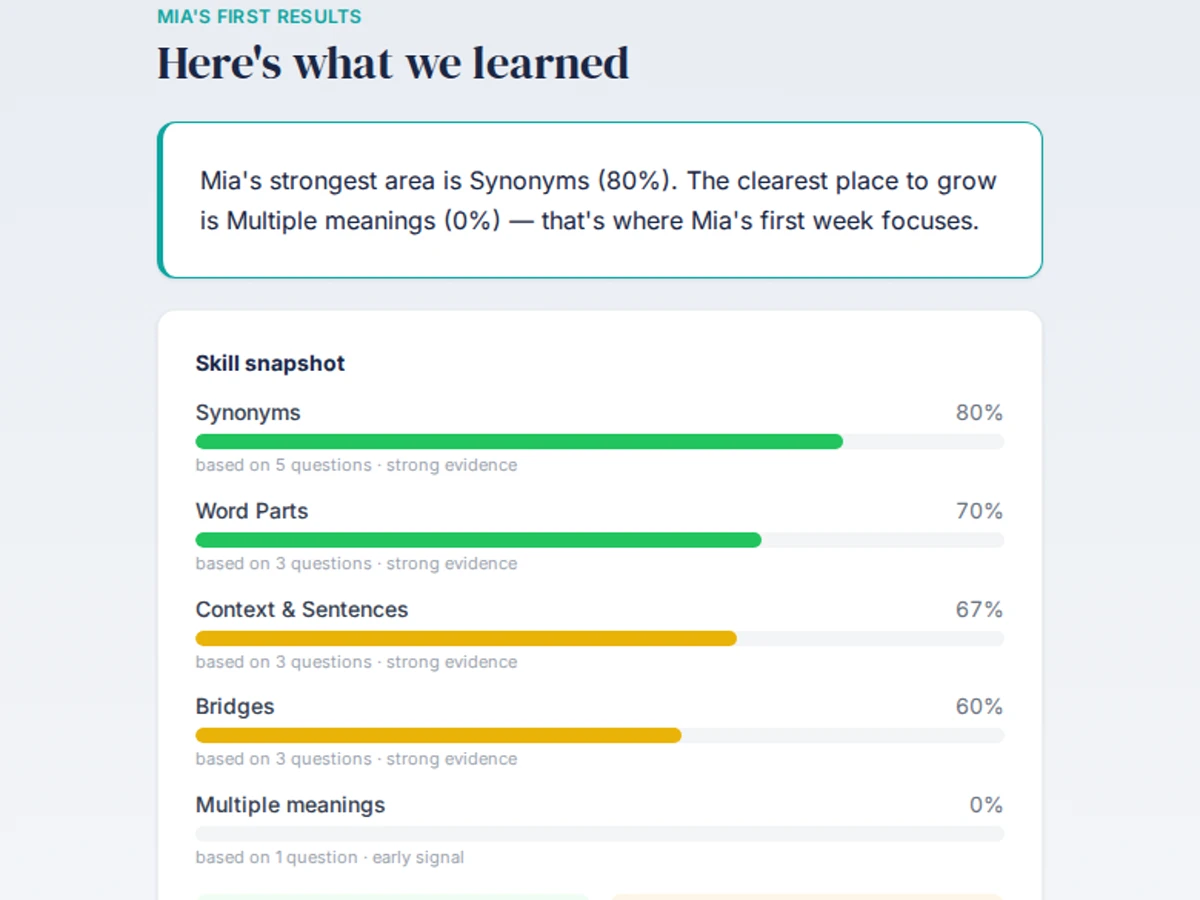
Start with a free, no-card vocabulary check-up and get a personalized parent report.
Find the vocabulary gaps — freeSee a sample parent report before starting
The check-up samples verbal skills and gives you an early strength, a growth area, and a first practice focus. It is not a full-length exam, an official SSAT or ISEE score, or an admissions prediction.
If your child is being assessed for gifted and talented placement using the Otis-Lennon School Ability Test, you are navigating one of the most widely used gifted screening tools in the United States. The OLSAT is the primary gifted identification test in major school districts including New York City (where it is used for Gifted & Talented Program placement), and many other districts across the country.
This guide covers everything parents need to know about the OLSAT verbal section: what it tests, how it is structured by grade level, how it compares to the CogAT, and what you can do to help your child prepare.
What Is the OLSAT?
The Otis-Lennon School Ability Test (OLSAT), published by Pearson, measures abstract reasoning and thinking skills in students from pre-kindergarten through grade 12. Like the CogAT, it is designed to measure cognitive ability rather than academic achievement — the focus is on how students think, not what they have been taught.
The OLSAT has two main sections:
- Verbal section: Tests language-based reasoning including verbal comprehension, verbal reasoning, and following directions
- Nonverbal section: Tests figure reasoning, number reasoning, and pattern completion
For gifted program placement, districts typically use a combination of the OLSAT score and academic achievement data. The OLSAT total score — called the School Ability Index (SAI) — has a mean of 100 and standard deviation of 16. Many districts require an SAI of 130 or above (approximately the 98th percentile) for gifted placement.
OLSAT Verbal Section: What It Tests
The OLSAT verbal section contains two main clusters: verbal comprehension and verbal reasoning. These clusters are tested across different subtests that vary by grade level.
Verbal Comprehension
Verbal comprehension items ask students to demonstrate understanding of written language, vocabulary, and following directions. At lower grade levels (K-2), many verbal comprehension items are read aloud by the teacher. At higher grade levels, students read items independently.
Following Directions: These items test whether students can decode complex multi-step instructions and identify which answer choice satisfies all conditions. Example: "Mark the shape that is neither the largest nor the darkest." This tests logical vocabulary (neither/nor, largest, darkest) and the ability to hold multiple conditions in working memory simultaneously.
Aural/Written Reasoning: Students are presented with a short sentence or paragraph and must identify which of several pictures or answers best matches the description. At higher levels, these become inference questions: what can be concluded from the passage?
Verbal Reasoning
Verbal reasoning items test the ability to identify relationships between words and concepts.
Antonyms and Synonyms: Students must identify the word most similar or most opposite to a given word. These items directly test vocabulary depth — the distinction between knowing a word at the surface level and understanding its precise meaning and semantic relationships.
Sentence Completion: A sentence with a missing word; students choose the best completion. This tests the intersection of vocabulary breadth and contextual reasoning. Context clues — contrast signals, cause-effect markers, definition phrases — are the key strategy.
Verbal Analogies: A:B :: C:? format with word pairs. The OLSAT uses a smaller set of relationship types than the CogAT, but the reasoning process is identical: identify the bridge relationship, then apply it to the new pair.
Logical Selection: "Find the word that fits with the group." This is the OLSAT equivalent of CogAT verbal classification — identifying category membership and selecting the word that belongs with a given set.
OLSAT by Grade Level (Forms A Through G)
The OLSAT is published in seven forms (A through G), corresponding to different grade-level bands. The verbal content shifts significantly across grade levels.
Form A (Grade K) and Form B (Grade 1)
At these levels, almost all verbal items are administered orally by the examiner. The child marks answers in a response booklet, but the questions are read aloud. This design ensures that reading ability does not obscure reasoning ability at early grades.
Verbal items at these levels focus on:
- Following multi-step directions with spatial and comparative language
- Picture-based verbal comprehension (identifying which picture matches a described situation)
- Simple sentence completion with familiar vocabulary
Prep emphasis: Oral language richness is the most important preparation factor at this level. Children who regularly encounter complex vocabulary in conversation and read-aloud sessions, who play verbal games, and who practice following directions with logical vocabulary (neither/nor, between, except) are well-positioned for Forms A and B.
Forms C and D (Grades 2-4)
The transition to fully independent reading begins here. Verbal items become more text-dependent, and vocabulary difficulty increases substantially from grade 2 to grade 4.
Verbal items at these levels add:
- Written sentence completion (more sophisticated vocabulary)
- Antonym and synonym pairs
- Early analogy questions
Prep emphasis: At these grades, root word knowledge begins to pay dividends. Children who know that -ful means "full of" and -less means "without" can infer joyful vs. joyless even if they have not memorized both words. Explicit vocabulary instruction organized around root families is the most efficient preparation strategy.
Forms E and F (Grades 5-8)
Verbal reasoning items become substantially more abstract at this level. Analogies use more sophisticated vocabulary; sentence completion items include longer sentences with more complex context; logical selection items require fine-grained semantic distinctions.
Prep emphasis: Systematic vocabulary study using spaced repetition. Students should be working through Latin and Greek roots, recognizing prefix-root-suffix patterns, and practicing analogy questions that require identifying abstract relationship types. Reading widely — particularly nonfiction and literary fiction — builds the vocabulary breadth that Forms E and F test.
Form G (Grades 9-12)
At this level, the OLSAT verbal battery includes some of the most sophisticated vocabulary and reasoning items of any school ability test. Analogies may involve abstract concepts, figurative meanings, or relationships between technical terms. Verbal comprehension passages are lengthy and require nuanced inference.
Prep emphasis: Deep vocabulary study, including academic vocabulary lists and domain-specific terms. Understanding how to break down unfamiliar words using roots and affixes is essential — encountering an unknown word on the test is unavoidable at this level, and root-based decoding is the most reliable fallback.
OLSAT vs. CogAT: What Parents Need to Know
Many parents encounter both tests — the OLSAT and the CogAT — and wonder about the differences. Here is a direct comparison:
| Feature | OLSAT | CogAT |
|---|---|---|
| Publisher | Pearson | Riverside Insights |
| Grade range | K-12 | K-12 |
| Verbal subtests | Verbal comprehension, verbal reasoning | Verbal analogies, verbal classification, sentence completion |
| Nonverbal/quantitative | Yes (combined nonverbal section) | Yes (separate quantitative and nonverbal batteries) |
| Score report | School Ability Index (SAI), percentile rank | Standard Age Score, percentile rank, stanine |
| Typical use | Gifted placement (NYC, many districts) | Gifted/advanced placement (national) |
| Administration | Group administered, pencil/paper | Group administered, paper or digital |
| Prep transferability | High — verbal reasoning skills transfer to CogAT | High — verbal reasoning skills transfer to OLSAT |
The most important thing to know: skills developed for CogAT verbal prep transfer directly to OLSAT verbal prep, and vice versa. Both tests measure verbal reasoning, vocabulary, and the ability to use context to make meaning. A child preparing for one is, in effect, preparing for both.
The structural difference that parents notice most is that the OLSAT emphasizes "following directions" items more than the CogAT does. These items test logical vocabulary — terms like except, unless, neither/nor, between/among, before/after — and the ability to hold multiple conditions simultaneously. This is worth practicing explicitly if your child is taking the OLSAT specifically.
OLSAT Verbal Prep Strategies
Strategy 1: Prioritize Oral Language for Young Children
For children in grades K-2, the verbal comprehension items are administered orally, meaning reading ability is not a factor. What matters is richness of oral language experience: the variety of words a child has heard, their ability to follow complex spoken instructions, and their comfort with formal vocabulary.
Parents can build oral language richness by:
- Reading aloud regularly, including books above the child's independent reading level
- Using precise vocabulary in everyday conversation ("The soup is simmering — that means it is almost boiling but not quite")
- Playing word games: "I'm thinking of a word that means very happy — it starts with 'el'..." (elated)
- Practicing following multi-step directions with logical vocabulary: "Put the red block on top of the blue one, but not the green one"
Strategy 2: Build Root Word Knowledge
For grades 3 and above, Latin and Greek root knowledge is the most efficient vocabulary preparation strategy. A student who knows the root spec/spect (to look) has a head start on inspect, spectator, perspective, retrospect, suspect, respect — all possible antonym, synonym, or analogy targets on the OLSAT verbal section.
See our SSAT word list organized by root families for a comprehensive root study list that transfers equally well to OLSAT preparation.
Strategy 3: Practice All OLSAT Verbal Item Types
Unlike the CogAT, which can be prepared for through general vocabulary and reasoning work, the OLSAT includes the "following directions" item type that benefits from specific format exposure. Practice items that require identifying which option satisfies multiple simultaneous conditions:
- "Circle the number that is greater than 5 but less than 9"
- "Mark the shape that is not a triangle and is not black"
- "Find the word that cannot mean happy: glad, gloomy, pleased, content"
The skill here is systematic elimination — testing each condition against each answer choice — which is explicitly teachable.
Strategy 4: Use Context Clues Strategically
For sentence completion items, teach your child a three-step process:
- Read the whole sentence before looking at answer choices
- Identify the signal words: contrast signals (but, however, although), cause-effect signals (because, therefore, as a result), and definition signals (which means, in other words)
- Predict the missing word before looking at options, then find the best match
This strategy works on every sentence completion format your child will encounter — OLSAT, CogAT, SSAT, ISEE, and beyond.
Strategy 5: Consistent Short Sessions Over Long Cram Sessions
The verbal reasoning skills the OLSAT tests — vocabulary depth, analogical reasoning, logical comprehension — are built through repeated practice over time, not through massed studying. Ten to fifteen minutes of daily verbal practice over eight to twelve weeks produces dramatically better results than two hours per day in the week before the test.
What to Expect on Test Day
Format and Timing
The OLSAT is a paper-and-pencil group test administered in the classroom or in a testing room. Timing is generous — the OLSAT is not designed to be a speeded test at most levels, though higher-level forms (F and G) do have tighter timing. Most students finish within the allotted time.
Your child will mark answers in a booklet or on a separate answer sheet. At grades K-2, the examiner reads questions aloud; at grades 3 and above, students read independently.
Score Reporting
OLSAT scores are reported as:
- Raw score: Number of correct answers
- SAI (School Ability Index): Age-normed standard score (mean 100, SD 16)
- Percentile rank: Compared to same-age national norms
- Age stanine: Performance band from 1 (lowest) to 9 (highest)
For gifted placement, districts typically use the SAI or percentile rank. NYC's Gifted & Talented program, for example, uses a composite of the OLSAT and NNAT (Naglieri Nonverbal Ability Test) scores. The verbal section score contributes approximately 45% of the composite in most OLSAT administrations.
Building Long-Term Verbal Ability
The most important point for parents to understand is that the skills you are building for the OLSAT — vocabulary depth, reasoning about word relationships, following logical instructions, using context to make meaning — are not just test skills. They are the academic language skills that predict success throughout schooling.
A child who leaves third grade with a foundation in Latin roots, comfort with analogy reasoning, and the habit of reading above grade level has not just prepared for one test. They have built a verbal capability that will serve them in every advanced English class, every college admissions essay, and every professional setting they encounter.
Prepare for the OLSAT with that long-term frame in mind, and the test will take care of itself.
Because the OLSAT is fundamentally a reasoning test, the verbal skills that most move your child's score are relational reasoning — recognizing the precise relationship in an analogy pair — and contextual inference — using surrounding sentence structure to identify the best completion. Root-word knowledge is the on-ramp that unlocks vocabulary breadth quickly, but it works alongside four other verbal domains: relational reasoning, contextual inference, test execution (systematic elimination, pacing), and metacognition (self-monitoring under time pressure). LexiMap trains all five and makes each visible on a parent dashboard, so your preparation targets what the OLSAT actually rewards.
Key Takeaways
- The OLSAT verbal section tests two clusters: verbal comprehension (following directions, aural/written reasoning) and verbal reasoning (antonyms, synonyms, sentence completion, analogies, logical selection).
- For grades K–2, oral language richness — read-alouds, word games, and practice with logical vocabulary — matters more than reading level because items are delivered orally.
- For grades 3 and above, root word knowledge is a strong on-ramp; skills developed for CogAT verbal transfer directly to OLSAT verbal, and vice versa — and relational reasoning practice on analogies is especially high-value given how reasoning-heavy the OLSAT is.
- "Following directions" items are unique to the OLSAT and benefit from explicit format practice using systematic elimination across multiple simultaneous conditions.
- Consistent short sessions (10–15 minutes daily over 8–12 weeks) produce dramatically better results than intensive study in the days before the test.
- The verbal skills built for OLSAT placement — vocabulary depth, analogical reasoning, context inference — are academic language skills that pay dividends across all future schooling.
LexiMap's verbal training adapts to the specific question formats of both the OLSAT and the CogAT verbal battery, building the root-word knowledge and reasoning skills that gifted placement tests measure. See how it works.
Get SSAT/ISEE vocabulary resources by email
Related Articles
ISEE Verbal Reasoning Strategies by Level: Primary Through Upper
Level-by-level ISEE verbal strategies for Primary through Upper Level. Vocabulary, sentence completion, and reading comprehension prep tailored to each grade band.
ISEE Vocabulary Builder: Best Tools and Strategies for 2026
Compare the best ISEE vocabulary building tools and strategies. Learn how root-based learning, spaced repetition, and targeted practice prepare students for ISEE verbal reasoning.
5 SSAT Analogy Strategies That Actually Work on Test Day
Master SSAT analogies with 5 proven strategies: bridge sentences, root word analysis, elimination technique, relationship reversal, and difficulty calibration.
Best ISEE Vocabulary Apps and Tools: A 2026 Comparison
Compare the best ISEE vocabulary prep apps — LexiMap, Quizlet, general vocabulary platforms, and practice tests. What actually prepares kids for ISEE synonyms and sentence completions.
Related Guides
SSAT Vocabulary List: 200+ Words Organized by Level and Root
Comprehensive SSAT vocabulary word lists organized by test level (Elementary, Middle, Upper) and root word family. Study the right words for your child's grade.
The Parent's Complete Guide to SSAT & ISEE Prep
Everything parents need to know about SSAT and ISEE preparation. Test formats, timelines, study strategies, score interpretation, and how to support your child's verbal growth.
SSAT® is a registered trademark of The Enrollment Management Association. ISEE® is a registered trademark of the Educational Records Bureau (ERB). LexiMap is not affiliated with or endorsed by these organizations.