Free CogAT Verbal Practice Questions: Analogies, Classification, Sentence Completion
Find your child’s vocabulary gaps
Start with a free, no-card vocabulary check-up and get a personalized parent report.
Find the vocabulary gaps — freeSee a sample parent report before starting
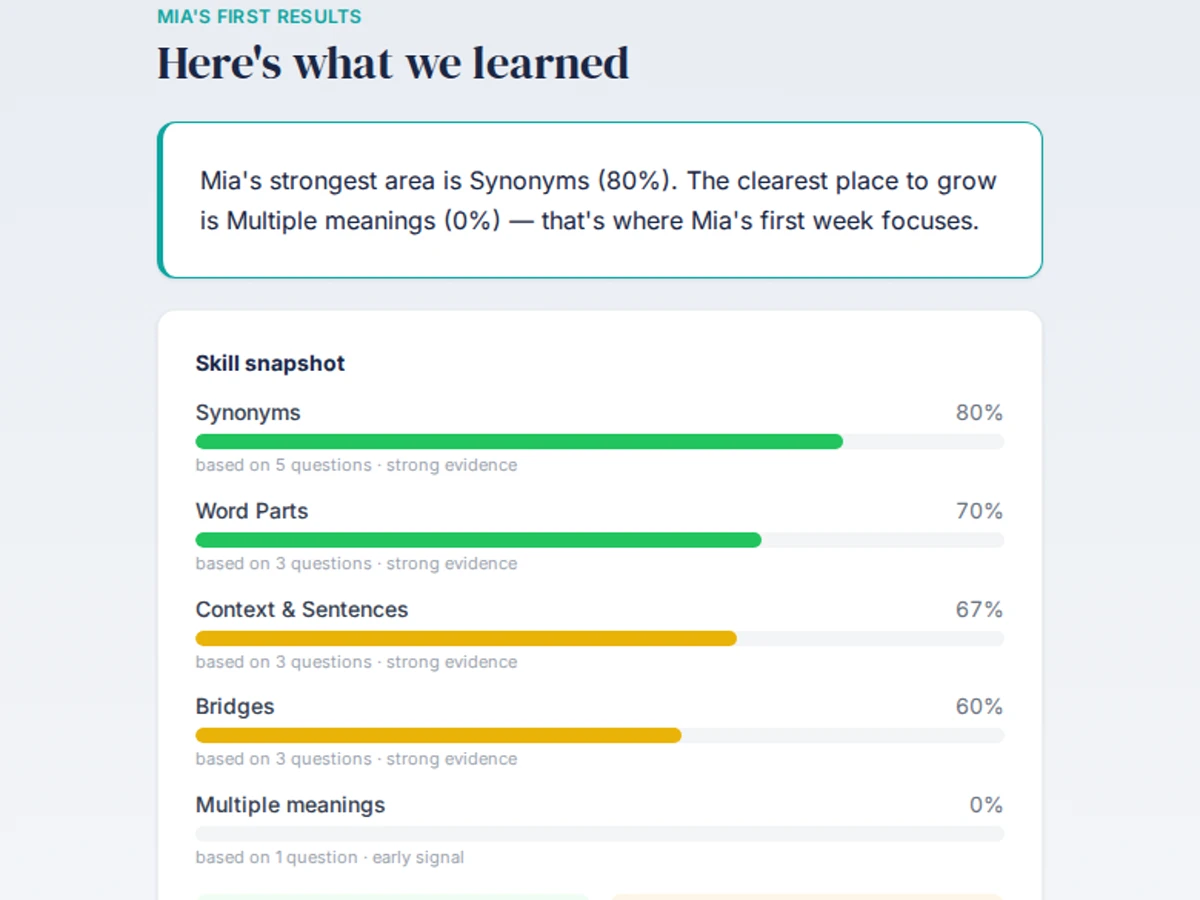
The check-up samples verbal skills and gives you an early strength, a growth area, and a first practice focus. It is not a full-length exam, an official SSAT or ISEE score, or an admissions prediction.
If your child is preparing for the CogAT verbal battery, practicing with real question formats is an essential part of preparation. This page provides free practice questions for all three CogAT verbal subtests — verbal analogies, verbal classification, and sentence completion — with complete explanations so you understand not just the correct answer but why it is correct.
These questions are designed to mirror the format, difficulty level, and reasoning demands of the actual CogAT verbal battery. They are not actual CogAT questions (those are proprietary to Riverside Insights), but they represent the same cognitive skills and question structures.
The practice here spans two of the five verbal domains LexiMap trains — Vocabulary Knowledge and Relational Reasoning — and the habits your child builds in these sessions transfer directly to the other three domains (Contextual Inference, Test Execution, and Metacognition) covered in LexiMap's full verbal curriculum.
Quick navigation:
- Verbal Analogies Practice (Grade 3-5)
- Verbal Analogies Practice (Grade 6-8)
- Verbal Classification Practice (Grade 3-5)
- Verbal Classification Practice (Grade 6-8)
- Sentence Completion Practice
- Tips for Each Question Type
Verbal Analogies Practice
Grade 3-5 Level (CogAT Levels 7-8)
For each analogy, identify the relationship between the first pair of words, then choose the word that completes the second pair in the same way.
Question 1
Puppy is to dog as kitten is to:
(A) cat (B) small (C) fur (D) meow (E) pet
Answer: A
Explanation: A puppy is the young form of a dog. A kitten is the young form of a cat. The relationship is "young animal to adult animal." Notice that choices (B) small and (C) fur are associated with kittens but do not complete the relationship correctly — the question asks for the adult form.
Bridge type: Characteristic relationship — young to adult
Question 2
Author is to novel as painter is to:
(A) canvas (B) gallery (C) portrait (D) color (E) brushstroke
Answer: C
Explanation: An author creates a novel; a painter creates a portrait. The relationship is "creator to their creation." Canvas (A) is what a painter uses, not what they create. A gallery (B) is where paintings are shown, not what a painter makes.
Bridge type: Worker to creation
Question 3
Hot is to cold as dark is to:
(A) night (B) shadow (C) light (D) dim (E) gloomy
Answer: C
Explanation: Hot and cold are opposites. The word opposite to dark is light. Notice that (D) dim and (E) gloomy are related to darkness but are not opposites of dark — dim means somewhat dark, and gloomy means sadly dark.
Bridge type: Antonyms
Question 4
Fin is to fish as wing is to:
(A) fly (B) feather (C) sky (D) bird (E) air
Answer: D
Explanation: A fin is a body part that belongs to a fish. A wing is a body part that belongs to a bird. The relationship is "body part to the animal that has it."
Bridge type: Part to whole (body part to organism)
Question 5
Scales is to fish as feathers is to:
(A) nest (B) soft (C) bird (D) wing (E) flying
Answer: C
Explanation: Scales are the covering of a fish. Feathers are the covering of a bird. The relationship is "body covering to the animal it covers." Note that this is similar to Question 4 but uses the covering specifically rather than a functional body part — this distinction is exactly the kind of precision the CogAT tests.
Bridge type: Characteristic feature (body covering to animal)
Grade 6-8 Level (CogAT Level 9+)
Question 6
Frugal is to spend as taciturn is to:
(A) talk (B) quiet (C) miser (D) reserved (E) money
Answer: A
Explanation: A frugal person tends not to spend (money). A taciturn person tends not to talk. The relationship is "adjective to the behavior the person is unlikely to do." Frugal means reluctant to spend; taciturn means reluctant to speak. The answer is what a taciturn person tends not to do: talk.
Bridge type: Characteristic avoidance (adjective to avoided behavior)
Question 7
Novice is to expert as apprentice is to:
(A) trade (B) master (C) learning (D) skill (E) workshop
Answer: B
Explanation: A novice is at the beginning level; an expert is at the advanced level. An apprentice is at the beginning level in a craft; a master is at the advanced level. The relationship is "beginner to advanced practitioner."
Bridge type: Degree/level — beginner to advanced
Question 8
Transparent is to opaque as articulate is to:
(A) clear (B) verbose (C) eloquent (D) inarticulate (E) speech
Answer: D
Explanation: Transparent (allows light through) is the opposite of opaque (does not allow light through). Articulate (expressing ideas clearly) is the opposite of inarticulate (unable to express ideas clearly). The relationship is antonyms.
Bridge type: Antonyms
Verbal Classification Practice
Grade 3-5 Level
For each question, three of the four words belong together in a group. Choose the word that does NOT belong.
Question 9
Which word does not belong?
(A) rose (B) daisy (C) oak (D) tulip
Answer: C — oak
Explanation: Rose, daisy, and tulip are all flowers. Oak is a tree, not a flower. Even though oak is a plant (a broader category that includes flowers), the specific category here is "flowers," and oak does not belong.
Question 10
Which word does not belong?
(A) hammer (B) screwdriver (C) wrench (D) ladder
Answer: D — ladder
Explanation: Hammer, screwdriver, and wrench are all tools used for building and repair (hand tools). A ladder is a piece of equipment used to reach high places — it is used in construction but is not a hand tool in the same sense. The category is "hand tools for fastening or building."
Question 11
Which word does not belong?
(A) proud (B) elated (C) joyful (D) content
Answer: A — proud
Explanation: Elated, joyful, and content all describe a feeling of happiness or pleasure. Proud describes a feeling of satisfaction about an achievement or possession — it is related to positive emotions but is specifically about self-evaluation, not general happiness. This is a harder version of the classification question, requiring fine-grained semantic precision.
Grade 6-8 Level
Question 12
Which word does not belong?
(A) diminish (B) wane (C) dwindle (D) amplify
Answer: D — amplify
Explanation: Diminish, wane, and dwindle all mean to become smaller or less. Amplify means to make larger or stronger — it is the opposite of the shared meaning.
Question 13
Which word does not belong?
(A) verbose (B) loquacious (C) garrulous (D) eloquent
Answer: D — eloquent
Explanation: Verbose, loquacious, and garrulous all mean talking too much or excessively. Eloquent means speaking fluently and persuasively — it describes speaking quality, not speaking quantity. An eloquent person speaks well; a loquacious person speaks too much. This is a classic near-category trap: all four words relate to speech, but three relate to quantity of speech and one relates to quality.
Question 14
Which word does not belong?
(A) obstinate (B) pertinacious (C) vacillating (D) tenacious
Answer: C — vacillating
Explanation: Obstinate, pertinacious, and tenacious all mean stubbornly persistent or holding firmly to a position. Vacillating means wavering back and forth — not holding firmly to any position at all. It is the antonym of the shared property.
Sentence Completion Practice
For each sentence, choose the word or phrase that best fills the blank.
Question 15
The detective was so ____ in her investigation that she refused to leave the case even after months of no new evidence.
(A) casual (B) tenacious (C) indifferent (D) bewildered (E) fortunate
Answer: B — tenacious
Explanation: The sentence describes someone who refuses to give up despite a long period with no progress. "Refused to leave the case" signals persistence. Tenacious (holding firmly to a goal) fits perfectly. Casual (A) is the opposite of intense dedication. Indifferent (C) means not caring — the opposite of what the sentence describes.
Question 16
Although the speaker was nervous before the presentation, she appeared completely ____ once she began, her voice steady and her arguments clear.
(A) terrified (B) disorganized (C) composed (D) confused (E) reluctant
Answer: C — composed
Explanation: The signal word although tells you the blank must contrast with "nervous." The blank describes someone who appeared the opposite of nervous once she began speaking. Composed (calm and controlled) fits. Note that the description "voice steady and arguments clear" confirms the answer.
Question 17
The scientist's findings were considered ____ because they directly contradicted theories that had been accepted for more than a century.
(A) conventional (B) expected (C) revolutionary (D) trivial (E) straightforward
Answer: C — revolutionary
Explanation: Something that "directly contradicts" accepted theories of a century's standing is not conventional (standard), expected, trivial, or straightforward. Revolutionary (causing a fundamental change in thinking) fits a finding that overturns long-established theory.
Question 18
The ancient treaty, once thought to be ____, was eventually broken when one nation decided its interests were no longer served by the agreement.
(A) temporary (B) inviolable (C) irrelevant (D) optional (E) fragile
Answer: B — inviolable
Explanation: The phrase "once thought to be ____" contrasts with what actually happened (it was broken). The blank needs a word meaning "unbreakable" or "sacred" — something the treaty was believed to be before it was violated. Inviolable means "never to be broken or dishonored." The sentence follows the structure: "thought to be [unbreakable], but eventually [broken]."
Tips for Each Question Type
For Verbal Analogies
Name the bridge before guessing. Read the stem pair and state the relationship explicitly in a sentence: "A ____ is the ____ of a ____." This prevents grabbing an answer that feels related without actually completing the relationship.
Watch for bridge precision. In Question 5 above, a student might confuse the "body covering" relationship with the "body part" relationship from Question 4. The specific type of relationship matters — sloppy bridge identification leads to wrong answers on harder questions.
Check your bridge against all answer choices before committing. If your bridge fits two choices, you have identified the wrong bridge. Re-examine the stem pair.
For Verbal Classification
Identify the precise category before looking at answer choices. In Question 13, the imprecise category would be "words about speech." The precise category is "words about talking too much." Only after identifying the precise category do you test each word against it.
The odd one out is often in the same broad category but the wrong sub-category. This is the most common classification trap — the distractor belongs to the broad category but not the specific one.
For Sentence Completion
Identify signal words first. Contrast signals (although, but, however, despite, yet) tell you the blank is opposite in direction to something else in the sentence. Similarity signals (also, similarly, just as) tell you the blank aligns with something else.
Predict the blank before looking at answers. Write or say a word that would fit before checking options. This protects you from choosing a "sounds right" trap answer.
Eliminate definitively wrong choices. Choices that contradict the sentence's logic can be eliminated quickly. Eliminating 2-3 wrong choices makes guessing (when necessary) much more accurate.
Key Takeaways
- All three CogAT verbal subtests reward the same underlying skills — precise word knowledge, relational reasoning, and careful context reading — so practice in one area transfers to the others.
- For analogies, naming the bridge relationship before looking at answer choices is the single most effective habit; it prevents choosing answers that feel related without completing the actual relationship.
- For classification, the distractor is typically in the same broad category but the wrong sub-category — your child needs to identify the precise category, not just any category the words share.
- For sentence completion, signal words (contrast: although, but, despite; similarity: also, similarly, just as) are the fastest route to the correct answer; teach your child to find these first.
- Both "name the bridge" and "predict the blank" strategies protect your child from trap answers designed to feel right while being subtly wrong.
- These question formats are learnable — brief, deliberate practice with each type removes the cognitive overhead of unfamiliar formats, freeing your child's reasoning capacity for the actual task.
For more CogAT verbal practice with adaptive difficulty and explanations, visit our CogAT prep page. For a full guide to the CogAT verbal battery and preparation strategies, see our complete CogAT verbal parent guide.
Get SSAT/ISEE vocabulary resources by email
Related Articles
Context Clues and Sentence Completion: The Craft of Reasoning to Meaning
Sentence completions reward reasoning, not just recall. How to teach your child to read context clues, weigh word charge, and solve completion questions with confidence.
Entrance Exam Test Dates 2026-2027: Complete Calendar
Complete 2026-2027 test date calendar for SSAT, ISEE, HSPT, TACHS, COOP, and CogAT. Registration deadlines, testing windows, and score release dates in one place.
ISEE Verbal Reasoning Strategies by Level: Primary Through Upper
Level-by-level ISEE verbal strategies for Primary through Upper Level. Vocabulary, sentence completion, and reading comprehension prep tailored to each grade band.
Signal Words: The Little Words That Solve Sentence Completions
However, because, despite — the small words that tell your child which direction a sentence turns. A parent's guide to teaching signal words for verbal reasoning.
Related Guides
ISEE Vocabulary: The Complete Guide to Root-Based Learning
Prepare for Lower, Middle, and Upper Level ISEE verbal reasoning with word roots, sentence-completion strategies, official exam-format sources, and a practical study plan.
SSAT Vocabulary: The Complete Guide to Root-Based Learning
Master SSAT vocabulary through Latin and Greek roots. Learn how root-based learning, spaced repetition, and interactive practice build lasting verbal skills for grades 4-12.
SSAT® is a registered trademark of The Enrollment Management Association. ISEE® is a registered trademark of the Educational Records Bureau (ERB). LexiMap is not affiliated with or endorsed by these organizations.