LexiMap vs. Test Innovators: SSAT Vocabulary Prep Compared
Find your child’s vocabulary gaps
Start with a free, no-card vocabulary check-up and get a personalized parent report.
Find the vocabulary gaps — freeSee a sample parent report before starting
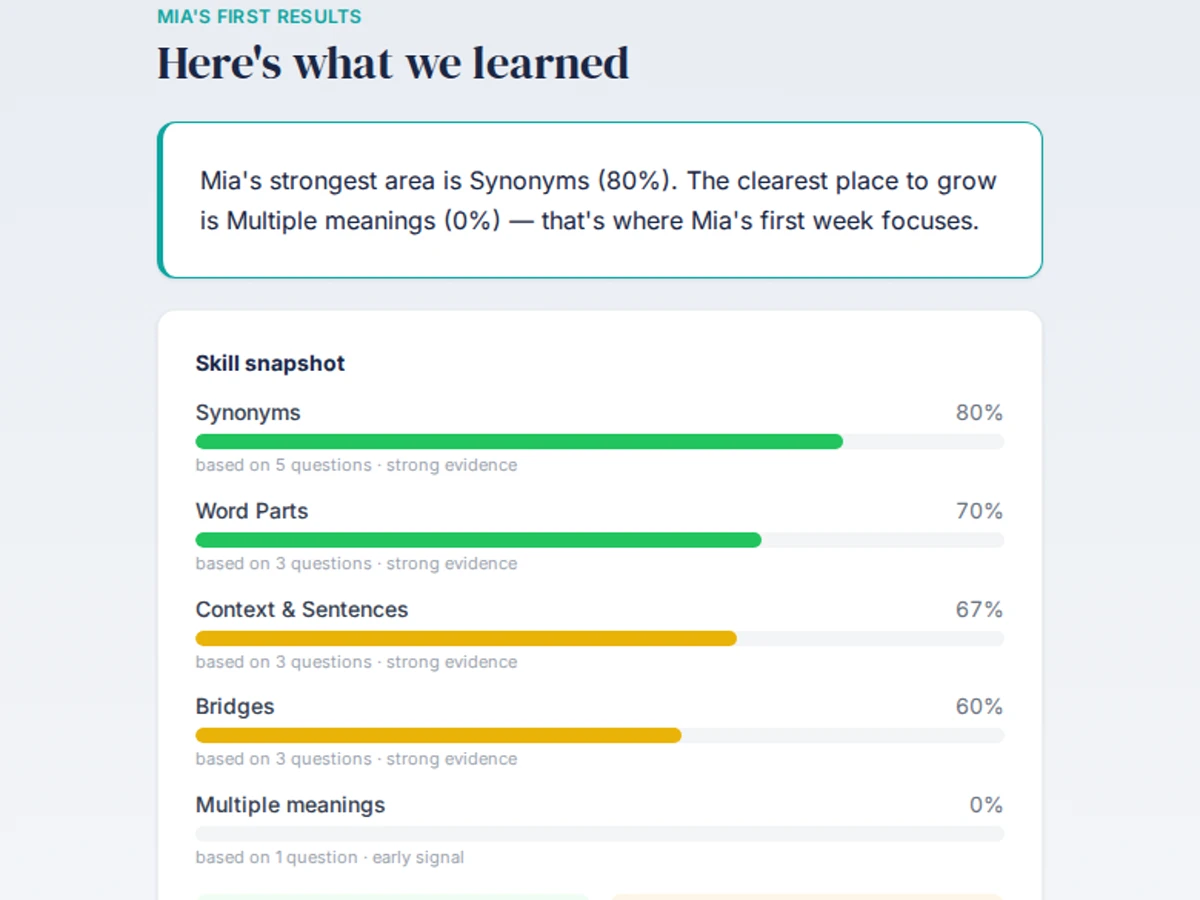
The check-up samples verbal skills and gives you an early strength, a growth area, and a first practice focus. It is not a full-length exam, an official SSAT or ISEE score, or an admissions prediction.
If you're researching SSAT prep tools, you've likely come across both LexiMap and Test Innovators . Both are well-regarded resources, but they serve fundamentally different purposes. Test Innovators provides realistic SSAT practice tests with scoring analytics. LexiMap builds the verbal skill foundation — across vocabulary, reasoning, inference, and test execution — that makes those practice tests productive.
This comparison is designed to help parents understand what each tool does well and how they can work together. Neither replaces the other — they address different stages and dimensions of SSAT preparation.
What Test Innovators Offers
Test Innovators is a practice-test platform built around full-length SSAT simulations. Students take timed tests that mirror the real exam's format, question types, and difficulty level. After each test, the platform provides a predicted score range, percentile estimate, and question-by-question explanations.
The platform's core strength is test-day simulation. Students become familiar with pacing, question formats, and the experience of sitting for a multi-section standardized test. The score prediction feature gives families a realistic sense of where their child stands before the actual exam. For students who have already built a solid vocabulary base, practice tests are an essential part of preparation — they reveal weak areas, build test-taking stamina, and reduce anxiety about the format.
What LexiMap Offers
LexiMap is a full verbal trainer for the SSAT and ISEE, built on root-based learning as its on-ramp. Beyond vocabulary, it trains the relational reasoning, contextual inference, test-execution, and metacognition skills the verbal section scores — and tracks all five on a parent dashboard.
The platform uses 9 interactive game modes — from root-to-meaning matching to analogy solving — combined with FSRS spaced repetition to build durable, long-term retention. The approach is structural: rather than recognizing a word you've drilled, you learn to decode unfamiliar words by identifying their component roots. This transferable skill pays dividends not only on the SSAT but across academic reading and future standardized tests. For more on this methodology, see our complete guide to Latin and Greek roots and FSRS methodology page.
More Than Roots: The Five-Domain Verbal Trainer
Roots are where your child starts, not where LexiMap stops. The SSAT and ISEE don't just test whether your child knows a word — they test five distinct verbal domains, and LexiMap trains all five:
- Vocabulary Knowledge — roots, word families, and connotation (the on-ramp).
- Relational Reasoning — analogy bridge types and synonym discrimination.
- Contextual Inference — sentence completions, signal words, and meaning from context.
- Test Execution — pacing, answer elimination, and guess discipline under time pressure.
- Metacognition — strategy selection, error awareness, and knowing when to skip.
Each domain shows up on the parent dashboard, so you can see exactly where your child is strong and where to focus — long before a full practice test would reveal the same gaps.
Feature-by-Feature Comparison
The table below compares both tools across the dimensions that matter most for SSAT verbal preparation. Neither tool "wins" every category — they excel in different areas by design.
The key distinction is when each tool is most valuable. Vocabulary acquisition is a slow, cumulative process that benefits from months of consistent spaced practice. Test simulation is most effective in the final weeks before the exam, when a student's knowledge base is established and the goal shifts to performance optimization.
Think of it this way: LexiMap builds verbal skill across all five domains — including question-level test execution like elimination and guess discipline. Test Innovators adds full-length, timed, multi-section simulation that no skill-trainer replaces. A student who takes practice tests without a solid verbal foundation will keep encountering the same gaps. A student who builds verbal skills but never practices under timed, full-test conditions may not perform at their true level on test day.
When to Use Each Tool
Use Test Innovators when your child needs to practice under realistic test conditions. This is most valuable in the 4–8 weeks before the exam. Practice tests help with pacing, format familiarity, and identifying specific question types that need more attention. They are also useful for establishing a baseline score early in the preparation process.
Use LexiMap when your child needs to build verbal skill across all five domains — vocabulary, relational reasoning, contextual inference, test execution, and metacognition — that make practice tests productive. This is most valuable 3–12 months before the exam, when there is time for spaced repetition to work. Daily sessions of 10–20 minutes build the root knowledge that allows students to decode unfamiliar words on test day, while the other four domains layer in question-level execution skills your child will need under real test conditions. For a detailed timeline, see our complete SSAT prep timeline guide.
The tools are complementary, not competing. A student who uses both will be better prepared than one who relies on either alone.
Using Both Together: A Recommended Approach
For families using both tools, here is a practical timeline that plays to each platform's strengths:
- Months 6–3 before test: LexiMap daily (10–15 min). Focus on mastering the top 50 roots and building the spaced repetition habit. No practice tests needed yet.
- Months 3–1 before test: LexiMap daily (15–20 min) plus one Test Innovators practice test every 2 weeks. Use practice test results to identify vocabulary gaps, then target those root families in LexiMap.
- Final month: LexiMap daily (10 min for review) plus one Test Innovators practice test per week. Focus shifts to test-day pacing and confidence. Track score trends to measure progress.
This approach gives vocabulary knowledge time to build and consolidate through spaced repetition, while practice tests provide realistic benchmarks and format familiarity at the stage when they matter most. For broader context on structuring an SSAT study plan, see our parent's guide to improving SSAT verbal scores.
Common objections
"Why not just use Test Innovators' practice tests?" Test Innovators brings official-format practice tests and the ERB/EMA credential. LexiMap brings adaptive, daily, skill-tracked verbal practice — the vocabulary, word parts, analogies, and context work that needs repetition every day. Different jobs — most serious preppers use both: LexiMap builds the skills, practice tests benchmark them.
Key Takeaways
- Test Innovators excels at practice test simulation, score prediction, and test-day readiness.
- LexiMap excels at building verbal skill across all five domains — vocabulary, relational reasoning, contextual inference, test execution, and metacognition — that make practice tests productive.
- The two tools address different stages of preparation and work best when used together.
- Start verbal skill training early (3–12 months out) and add practice tests later (4–8 weeks out) for the strongest results — a principle aligned with learning science research on distributed practice.
- Neither tool alone is a complete SSAT verbal prep solution — combining five-domain skill training with full-length timed practice tests covers both dimensions.
Questions parents ask
Is Test Innovators or LexiMap better for SSAT/ISEE prep?
They do different jobs: Test Innovators is practice-test infrastructure — full-length tests, scoring, pacing. LexiMap builds the vocabulary and verbal skill those tests measure. Serious prep usually wants both jobs done.
Do we need both tools?
For a student more than a couple of months out, a vocabulary builder first, then practice tests closer to test day is the standard sequence. Inside the final weeks, practice tests take priority and vocabulary work patches the gaps they reveal.
Does LexiMap include practice tests?
No. LexiMap trains vocabulary and verbal skills — synonyms, analogies, sentence completions — through daily game-based sessions. It deliberately does not include full-length practice tests, reading-comprehension passages, math, or essay practice.
Get SSAT/ISEE vocabulary resources by email
Related Articles
Best SSAT Vocabulary Apps and Tools: A 2026 Comparison
Compare the best SSAT vocabulary prep tools — LexiMap, Quizlet, Anki, practice tests, and vocabulary apps. See which approach actually builds lasting verbal skills.
Best Vocabulary Apps for Private-School Admissions Tests (2026)
Compare vocabulary prep apps for private-school entrance exams — SSAT, ISEE, HSPT, and more. What to look for, honest tool comparisons, and how to choose for your child.
Best ISEE Vocabulary Apps and Tools: A 2026 Comparison
Compare the best ISEE vocabulary prep apps — LexiMap, Quizlet, general vocabulary platforms, and practice tests. What actually prepares kids for ISEE synonyms and sentence completions.
LexiMap vs. Membean for SSAT and ISEE Vocabulary Prep
Compare LexiMap and Membean for grades 6–12 vocabulary learning and focused SSAT/ISEE verbal practice, including personal-plan access and where each tool fits.
Related Guides
SSAT Vocabulary List: 200+ Words Organized by Level and Root
Comprehensive SSAT vocabulary word lists organized by test level (Elementary, Middle, Upper) and root word family. Study the right words for your child's grade.
The Parent's Complete Guide to SSAT & ISEE Prep
Everything parents need to know about SSAT and ISEE preparation. Test formats, timelines, study strategies, score interpretation, and how to support your child's verbal growth.
SSAT® is a registered trademark of The Enrollment Management Association. ISEE® is a registered trademark of the Educational Records Bureau (ERB). LexiMap is not affiliated with or endorsed by these organizations.