LexiMap vs. Quizlet: Which Is Better for SSAT Vocabulary?
Find your child’s vocabulary gaps
Start with a free, no-card vocabulary check-up and get a personalized parent report.
Find the vocabulary gaps — freeSee a sample parent report before starting
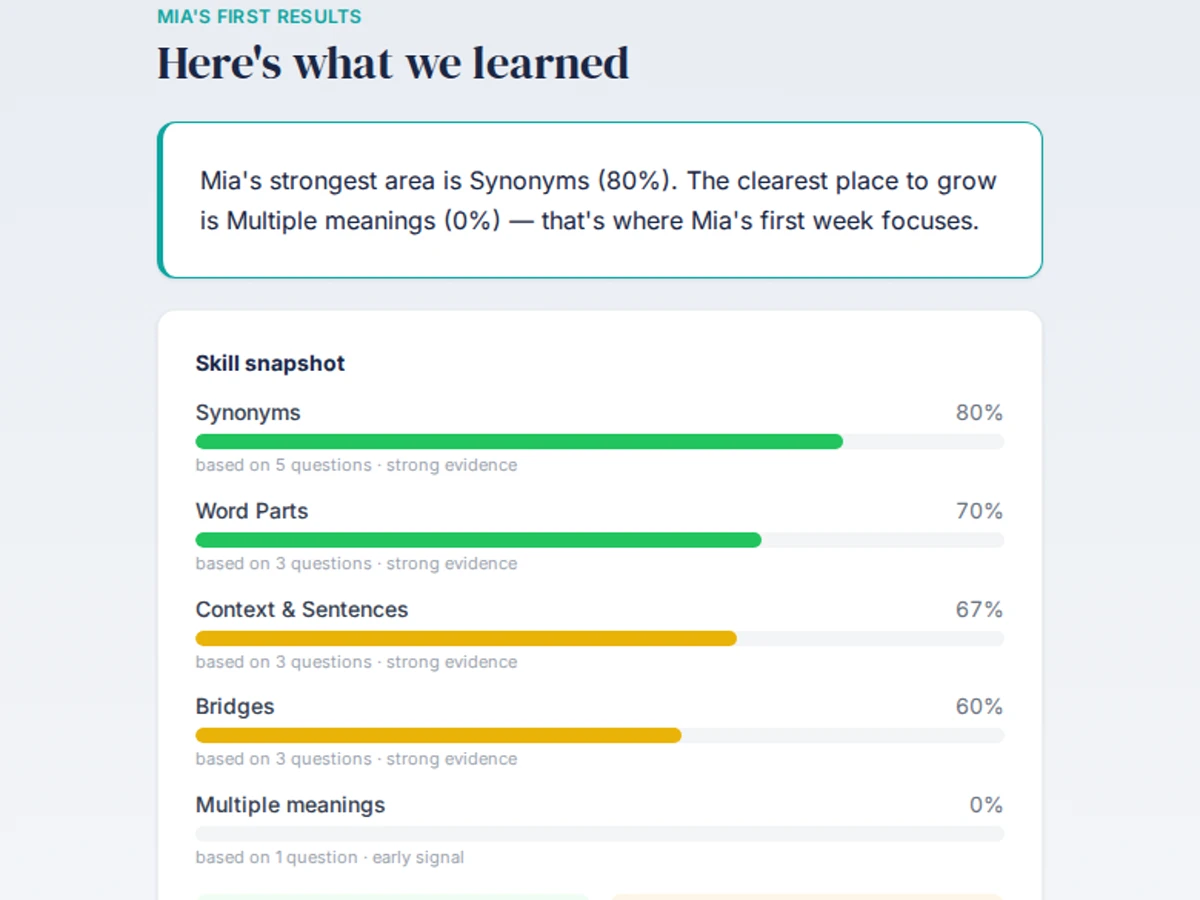
The check-up samples verbal skills and gives you an early strength, a growth area, and a first practice focus. It is not a full-length exam, an official SSAT or ISEE score, or an admissions prediction.
If your child is preparing for the SSAT, chances are they already use Quizlet . It's the most popular digital study tool among students — over 60 million monthly active users — and it's genuinely good at what it does. But "good at what it does" and "best for SSAT vocabulary" aren't the same thing.
This comparison looks at both tools honestly. Quizlet has real strengths that LexiMap doesn't replicate. LexiMap has capabilities that Quizlet wasn't designed to offer. The right choice depends on what your child needs. Let's break it down.
What Quizlet Offers
Quizlet is a general-purpose study platform built around user-created flashcard decks. Its core value proposition is flexibility: students can study anything, from Spanish verb conjugations to AP Biology terms. For vocabulary, the typical workflow is creating (or finding) a deck of word-definition pairs and cycling through them in various study modes.
Quizlet's study modes include flashcard review, a matching game, a "Learn" mode that adapts question types based on performance, and a "Test" mode that generates mock quizzes. The free tier is ad-supported. Quizlet Plus ($35.99/year) removes ads and adds features like custom images and offline access.
The platform's greatest strength is its community content library. Searching "SSAT vocabulary" on Quizlet returns thousands of decks created by other students, tutors, and parents. This means you can get started in minutes without creating anything yourself. The trade-off is quality control: community decks vary enormously in accuracy, completeness, and pedagogical value. Some are excellent. Many contain errors, inconsistent formatting, or irrelevant words.
What LexiMap Offers
LexiMap is a purpose-built vocabulary learning platform designed specifically for SSAT and ISEE preparation. Rather than teaching words one at a time, LexiMap teaches the 182 root families (291 word parts) that underlie the majority of standardized test vocabulary. Every root, example word, and game mode in the platform was curated for this purpose.
LexiMap uses FSRS spaced repetition to schedule reviews, adapting to each child's individual memory profile. 18 interactive game modes — from root-to-meaning matching to word-building and contextual identification — keep practice varied and engaging. A parent dashboard tracks progress, mastery rates, and study consistency.
LexiMap's strength is depth across the whole verbal section. Roots are the on-ramp, but LexiMap trains all five domains the SSAT and ISEE measure — vocabulary knowledge, relational reasoning, contextual inference, test execution, and metacognition — with curated content, FSRS scheduling, and a parent dashboard that shows growth in each, designed for children ages 8 to 16. For a complete overview of the approach, see our SSAT Vocabulary Guide and FSRS methodology.
Feature-by-Feature Comparison
The table below compares the two platforms across the dimensions that matter most for SSAT vocabulary preparation. We've aimed to be straightforward about where each tool has an advantage.
| Feature | Quizlet | LexiMap |
|---|---|---|
| Content quality | User-generated; quality varies widely | Curated 182-root-family curriculum |
| Learning method | Word-by-word flashcards | Root-based (one root unlocks many words) |
| Spaced repetition | Basic (Learn mode adapts) | FSRS algorithm (adaptive per learner) |
| SSAT/ISEE focus | General-purpose; relies on community decks | Purpose-built for SSAT/ISEE verbal |
| Practice modes | 4 modes (flashcards, learn, match, test) | 18 game modes designed for root learning |
| Progress tracking | Per-deck accuracy stats | Parent dashboard with mastery & streaks |
| Content scope | Unlimited (any subject) | Full SSAT/ISEE verbal: vocabulary, analogies, sentence completions |
| Cost | Free (ads) / $35.99/yr (Plus) | Free trial, then subscription |
| Best for | General studying across all subjects | Full verbal trainer + parent dashboard |
Both tools have legitimate advantages. Quizlet's breadth is unmatched — if your child also needs to study for science, history, or a foreign language class, Quizlet handles all of those. LexiMap's depth is unmatched for its specific domain — every design decision, from the curriculum to the game modes to the spaced repetition implementation, was made to optimize SSAT vocabulary outcomes.
The Root-Based Difference
The most fundamental difference between the two tools isn't a feature — it's the learning model. Quizlet teaches vocabulary word by word: one card equals one word. If a student needs to learn 500 SSAT words, they create 500 flashcards. Each word is an independent item with no structural connection to the others.
LexiMap teaches the building blocks. Instead of 500 isolated words, students learn the roots, prefixes, and suffixes that compose those words. The root spec/spect (to look) unlocks inspect, spectacle, perspective, retrospect, spectrum, and circumspect in a single conceptual group. One root, six words — and the pattern scales across all 182 root families in the curriculum.
This structural approach has a concrete advantage on test day: when students encounter an unfamiliar word, root knowledge lets them decode its meaning. A student who recognizes bene (good) and vol (wish) in "benevolent" can work out the meaning even if they've never studied the word directly. Flashcard-based learning offers no comparable fallback — if the word wasn't on a card, the student has to guess.
For a deeper exploration of this distinction, see our article on root words vs. flashcards.
More Than Roots: The Five-Domain Verbal Trainer
Roots are where your child starts, not where LexiMap stops. The SSAT and ISEE don't just test whether your child knows a word — they test five distinct verbal domains, and LexiMap trains all five:
- Vocabulary Knowledge — roots, word families, and connotation (the on-ramp).
- Relational Reasoning — analogy bridge types and synonym discrimination.
- Contextual Inference — sentence completions, signal words, and meaning from context.
- Test Execution — pacing, answer elimination, and guess discipline under time pressure.
- Metacognition — strategy selection, error awareness, and knowing when to skip.
Each domain shows up on the parent dashboard, so you can see exactly where your child is strong and where to focus — not just a per-deck accuracy stat.
Which Should You Choose?
Choose Quizlet if your child needs a free, general-purpose study tool for multiple subjects and you're willing to invest time finding or creating high-quality SSAT vocabulary decks. Quizlet is especially good for students who are self-motivated and enjoy creating their own study materials — the act of building a deck is itself a form of active learning.
Choose LexiMap if your child is specifically preparing for the SSAT or ISEE verbal section and you want a structured, research-backed approach that doesn't require you to curate content yourself. LexiMap is especially good for students who benefit from guided, game-based practice with adaptive scheduling — and for parents who want visibility into their child's progress.
The two tools aren't mutually exclusive. Some families use Quizlet for school subjects and LexiMap for SSAT prep. The important thing is that whatever tool your child uses for test vocabulary, it incorporates spaced repetition and goes beyond simple memorization. A tool that teaches why words mean what they mean — not just that they mean it — produces skills that transfer to unfamiliar words on test day.
Common objections
"Quizlet is free — why pay?" Free gets you a deck to shuffle; it doesn't get you a plan. LexiMap decides what to review and when, teaches the word-parts that unlock new words, and shows you a skill map. Free is a tool — this is the system that runs the prep. Keep Quizlet for quick review.
"Isn't this just a glorified flashcard app?" A flashcard app shows a card. LexiMap trains five core verbal skill domains, adapts every session to what your child missed, and shows you a skill-by-skill map. Start the free trial and watch the difference in one session.
Key Takeaways
- Quizlet is a strong general-purpose study tool with unmatched flexibility and a massive community content library. It's free to start and works for any subject.
- LexiMap is purpose-built for SSAT/ISEE vocabulary with a curated root-based curriculum, FSRS adaptive spaced repetition, and 18 interactive game modes designed for children.
- The core difference is the learning model: Quizlet teaches word by word; LexiMap teaches the roots that compose words — an approach supported by morphological instruction research — enabling students to decode unfamiliar vocabulary on test day.
- Quizlet wins on breadth and price. LexiMap wins on SSAT focus, content curation, and adaptive scheduling.
- They can complement each other — Quizlet for school, LexiMap for test prep. The key is that your SSAT vocabulary tool uses spaced repetition and teaches structural word knowledge.
Questions parents ask
Is Quizlet good enough for SSAT or ISEE vocabulary?
As a supplement, yes; as the primary method, usually not. Quizlet is free and easy, but decks aren't curated to SSAT/ISEE vocabulary and its review scheduling is basic rather than FSRS-adaptive — the two things that matter most for test-day retention.
What does LexiMap do that Quizlet doesn't?
Exam-aligned content built on Latin and Greek roots, automatic FSRS spaced repetition, question-format practice (analogies, sentence completions), and a parent dashboard. Quizlet wins on price and flexibility for self-made decks.
Can we use both?
Yes — a common setup is LexiMap for the daily structured habit and Quizlet for quick self-made review of school-specific lists. If you only keep one for admissions-test prep, keep the one that schedules reviews for you.
Get SSAT/ISEE vocabulary resources by email
Related Articles
Best SSAT Vocabulary Apps and Tools: A 2026 Comparison
Compare the best SSAT vocabulary prep tools — LexiMap, Quizlet, Anki, practice tests, and vocabulary apps. See which approach actually builds lasting verbal skills.
Best Vocabulary Apps for Private-School Admissions Tests (2026)
Compare vocabulary prep apps for private-school entrance exams — SSAT, ISEE, HSPT, and more. What to look for, honest tool comparisons, and how to choose for your child.
LexiMap vs. Membean for SSAT and ISEE Vocabulary Prep
Compare LexiMap and Membean for grades 6–12 vocabulary learning and focused SSAT/ISEE verbal practice, including personal-plan access and where each tool fits.
LexiMap vs. Test Innovators: SSAT Vocabulary Prep Compared
Side-by-side comparison of LexiMap and Test Innovators for SSAT vocabulary preparation. See how root-based learning with spaced repetition compares to traditional practice tests.
Related Guides
SSAT Vocabulary: The Complete Guide to Root-Based Learning
Master SSAT vocabulary through Latin and Greek roots. Learn how root-based learning, spaced repetition, and interactive practice build lasting verbal skills for grades 4-12.
SSAT Vocabulary List: 200+ Words Organized by Level and Root
Comprehensive SSAT vocabulary word lists organized by test level (Elementary, Middle, Upper) and root word family. Study the right words for your child's grade.
SSAT® is a registered trademark of The Enrollment Management Association. ISEE® is a registered trademark of the Educational Records Bureau (ERB). LexiMap is not affiliated with or endorsed by these organizations.