SSAT Prep Cost Breakdown: What Parents Actually Spend in 2026
Find your child's SSAT vocabulary gaps
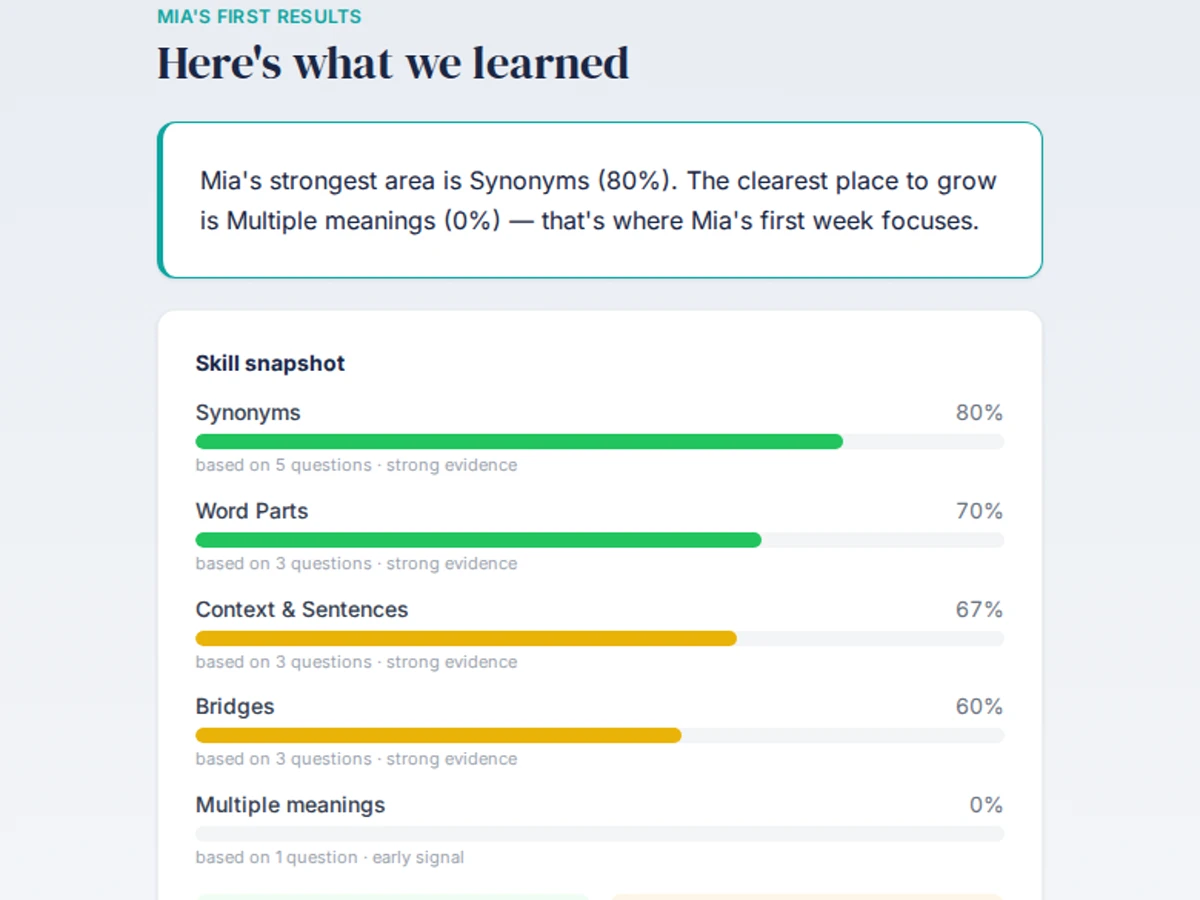
Start with a free, no-card SSAT check-up — 30 questions with a personalized parent report.
Find the SSAT vocabulary gaps — freeSee a sample parent report before starting
The check-up samples verbal skills and gives you an early strength, a growth area, and a first practice focus. It is not a full-length exam, an official SSAT or ISEE score, or an admissions prediction.
SSAT preparation costs range from virtually nothing to well over $10,000 — and the most expensive option isn't always the most effective one. As a parent, you're trying to balance your child's best chance of admission against a realistic budget, and the prep industry doesn't make that easy. Tutoring centers quote hourly rates without disclosing total costs. Course providers bury the true price behind "packages." And free resources are hard to evaluate without knowing what actually works.
This guide breaks down what each category of SSAT preparation actually costs in 2026, what you get for your money, and where your dollars produce the most vocabulary growth per hour. All figures are estimates based on publicly available pricing — your actual costs will vary by location, provider, and how long your child prepares.
The Full Cost Picture
Before diving into each category, here's what the landscape looks like at a glance. These are estimated cost ranges for 2026 based on publicly available pricing:
| Category | Cost Range | Notes |
|---|---|---|
| Test registration | $75–$310 | Standard vs. late registration; fee waivers available |
| Private tutoring | $50–$200/hr | Typically weekly for 3–6 months |
| Group tutoring / courses | $200–$1,500 total | 6–12 week programs |
| Vocabulary & prep apps | $0–$30/mo | Free tiers available; premium adds features |
| Prep books | $15–$50 each | One-time purchase |
| Practice tests | $0–$100+ | Official tests cost more; some free online |
A family using only free resources and the registration fee might spend under $100. A family combining private tutoring, a premium course, and multiple practice tests could spend $5,000–$10,000 over six months. Most families land somewhere in between.
Tutoring: The Biggest Line Item
Private tutoring is typically the largest single expense in SSAT preparation, and the price range is wide:
- Independent tutors: $50–$125/hr, depending on experience and location. Online tutors tend toward the lower end; in-person tutors in major metro areas toward the higher end.
- Tutoring center specialists: $100–$200/hr through established test prep companies. You're paying for the company's curriculum and brand, not just the tutor's time.
- Group tutoring: $30–$75/hr per student, typically in groups of 3–8. Lower cost per hour, but less individualized attention.
The typical engagement is one session per week for 3–6 months. At the low end (independent tutor, $75/hr, 12 sessions), that's about $900. At the high end (center specialist, $175/hr, 24 sessions), it's $4,200. Most families we hear from spend $1,200–$3,000 on tutoring alone.
When tutoring is worth it: Tutoring is most valuable when your child has specific, identifiable weaknesses — difficulty with analogies, poor time management, test anxiety — that benefit from expert, individualized guidance. A good tutor diagnoses the problem and addresses it directly.
When it's not: If your child's primary need is building vocabulary, a tutor spending an hour per week on word lists is an expensive way to do what a daily spaced-repetition app does every day. The tutor's time is better spent on strategy, not drilling.
Apps and Online Tools: The Best Value for Vocabulary
Digital tools are the most cost-effective category for vocabulary building, and it's not close. The major options in 2026:
- LexiMap — Root-based vocabulary with FSRS spaced repetition, 18 game modes, and SSAT/ISEE-targeted word pool. Subscription-based.
- Quizlet — General-purpose flashcard platform. Free tier with ads; Quizlet Plus removes ads and adds AI features (~$8/mo). Requires finding or building SSAT-specific decks.
- Anki — Open-source spaced repetition. Free on desktop, ~$25 one-time on iOS. Powerful but requires setup and user-created decks.
- Test Innovators — SSAT-specific practice platform with adaptive diagnostics. ~$40–$100 for a subscription period. Strong on practice tests, lighter on vocabulary building.
The cost per month of actual prep time is remarkably low across all of these. Even the premium options run $10–$30/month — less than a single hour of tutoring. The key differences are in what they teach and how they teach it. Flashcard apps teach individual words through repetition; root-based apps teach transferable patterns that unlock entire word families. For a detailed comparison, see our 2026 comparison of SSAT vocabulary apps.
For vocabulary specifically, apps with built-in spaced repetition are the clear winner on a cost-per-word-learned basis. They automate the scheduling that parents would otherwise need to manage manually, and they scale daily practice to exactly the right difficulty level.
Books and Practice Tests: Good Supplements, Not Standalone Solutions
Prep books and practice tests are the traditional backbone of test preparation, and they still have a role — just not as the primary vocabulary-building tool.
- Official SSAT prep book (~$30): Published by the Enrollment Management Association. Contains real test questions and two full practice tests. Essential for understanding the actual test format.
- Kaplan / Princeton Review SSAT guides ($20–$40): Third-party guides with strategies, vocabulary lists, and practice questions. Quality varies; some are more current than others.
- Official practice tests ($25–$50 each): Available through ssat.org. The closest approximation of the real testing experience. Most families purchase 2–4 over the course of preparation.
- Free practice questions: Available from several providers, though quality and SSAT alignment vary. Good for initial assessment, less reliable for score prediction.
Total cost for books and tests: typically $50–$200 over the full preparation period. These are one-time purchases that provide good value, but they share a limitation: they test vocabulary rather than teach it. A student who doesn't know a word before taking a practice test still won't know it after seeing it once in a question. Books and tests are diagnostic tools, not learning tools.
The Hidden Cost: Time
The dollar cost of SSAT prep is only part of the equation. The time cost — for both parents and children — is often the larger burden and the one least discussed.
Parent time: Without automated tools, parents often become de facto study managers — a challenge well-recognized in independent school admission circles — selecting vocabulary lists, quizzing their child, tracking progress, adjusting the plan. This can easily consume 3–5 hours per week of parent time on top of the child's study time. Over a four-month prep period, that's 50–80 hours of parent involvement.
Child time: Typical SSAT preparation involves 3–6 months of regular study. The total hours depend on intensity: a light approach (15 min/day) adds up to about 45 hours over three months; an intensive approach (45 min/day) reaches 135 hours. Neither is "wasted" time — vocabulary knowledge transfers to schoolwork and reading — but it is time that could be spent on other activities.
Tools with built-in scheduling and progress tracking significantly reduce parent management time. Spaced repetition apps like LexiMap automate the "what to study today" decision entirely — the child opens the app, practices the roots the algorithm has scheduled, and closes it. No parent curation required. Over a four-month prep period, this can save parents dozens of hours while producing better vocabulary retention than manual flashcard management.
Most Cost-Effective Approaches by Budget
Not every family has the same budget for test prep, and that's fine. Here's what we'd recommend at three budget levels:
Under $50/month
- Root-based vocabulary app with spaced repetition (best single investment for verbal score)
- Free practice questions for format familiarity
- One official prep book (~$30 one-time)
- Daily 15-minute practice habit
Total estimated cost: $50–$150 over 3–4 months. This is the highest-value approach for vocabulary building.
$50–$200/month
- Everything in the under-$50 tier
- 2–3 official practice tests ($50–$150 total) for score benchmarking
- Practice test platform subscription for adaptive diagnostics
- Optional: monthly group tutoring sessions for strategy coaching
Total estimated cost: $300–$800 over 3–4 months. Adds diagnostic depth and test-taking strategy.
$200+/month
- Everything in the $50–$200 tier
- Weekly private tutoring focused on weak areas (not vocabulary drilling)
- Full suite of official practice tests
- Premium app subscriptions
Total estimated cost: $1,500–$5,000+ over 3–6 months. Justified when targeting competitive admissions or addressing specific skill gaps.
At every budget level, the foundation is the same: root-based vocabulary learning with spaced repetition, practiced daily. The higher tiers add diagnostic testing and expert guidance, but the vocabulary foundation drives the largest share of verbal score improvement. A student using a daily spaced-repetition app with genuine consistency will often outperform a student with a $200/hour tutor who practices sporadically.
When evaluating what each dollar buys, it helps to know what the SSAT actually tests. Roots are the on-ramp into vocabulary knowledge, but the SSAT rewards five verbal domains: vocabulary knowledge, relational reasoning, contextual inference, test execution (pacing, elimination, guess discipline, and stamina), and metacognition. A vocabulary app that only drills word definitions is training one of the five. LexiMap is built as a five-domain trainer — its parent dashboard surfaces Test Execution Skills, Learning Skills, and Behavioral Skills separately, so you can see where your dollar is producing results, not just whether a word was memorized.
Key Takeaways
- SSAT prep costs range from under $100 to over $10,000. The most expensive approach isn't necessarily the most effective.
- Private tutoring is the biggest cost ($1,200–$4,200 typical). It's most valuable for strategy and targeted weaknesses, not vocabulary drilling.
- Vocabulary apps ($0–$30/month) are the most cost-effective tool for building the word knowledge that drives verbal scores. Root-based apps with spaced repetition offer the best return per dollar.
- Books and practice tests ($50–$200 total) are good supplements for format familiarity and score benchmarking, but they test knowledge rather than build it.
- The hidden cost of parent time is significant. Tools with automated scheduling and progress tracking save parents dozens of hours over a typical prep period.
- At any budget, daily consistency with root-based learning is the single highest-impact investment for SSAT verbal preparation.
Get SSAT/ISEE vocabulary resources by email
Related Articles
How to Improve Your Child's SSAT Verbal Score: A Parent's Guide
Evidence-based strategies to raise your child's SSAT verbal score. Root-based learning, spaced repetition, daily habits, and realistic improvement timelines.
The 90-Day SSAT Vocabulary Prep Plan for Parents
A week-by-week SSAT study schedule parents can actually follow — 15 minutes a day, five phases, from baseline diagnostic to test-day confidence.
SSAT Vocabulary Prep: The Complete Parent Guide
Everything parents need to know about SSAT vocabulary prep — what the verbal section tests, how scoring works, and the strategies that build lasting vocabulary mastery.
SSAT vs ISEE: Which Test Does Your Child Need?
SSAT or ISEE? This honest comparison covers format, scoring, school preferences, and a clear decision framework to help you choose the right test for your child.
Related Guides
The Parent's Complete Guide to SSAT & ISEE Prep
Everything parents need to know about SSAT and ISEE preparation. Test formats, timelines, study strategies, score interpretation, and how to support your child's verbal growth.
SSAT Vocabulary List: 200+ Words Organized by Level and Root
Comprehensive SSAT vocabulary word lists organized by test level (Elementary, Middle, Upper) and root word family. Study the right words for your child's grade.
SSAT® is a registered trademark of The Enrollment Management Association. ISEE® is a registered trademark of the Educational Records Bureau (ERB). LexiMap is not affiliated with or endorsed by these organizations.