How to Help Your Child Prepare for CogAT Verbal
Find your child’s vocabulary gaps
Start with a free, no-card vocabulary check-up and get a personalized parent report.
Find the vocabulary gaps — freeSee a sample parent report before starting
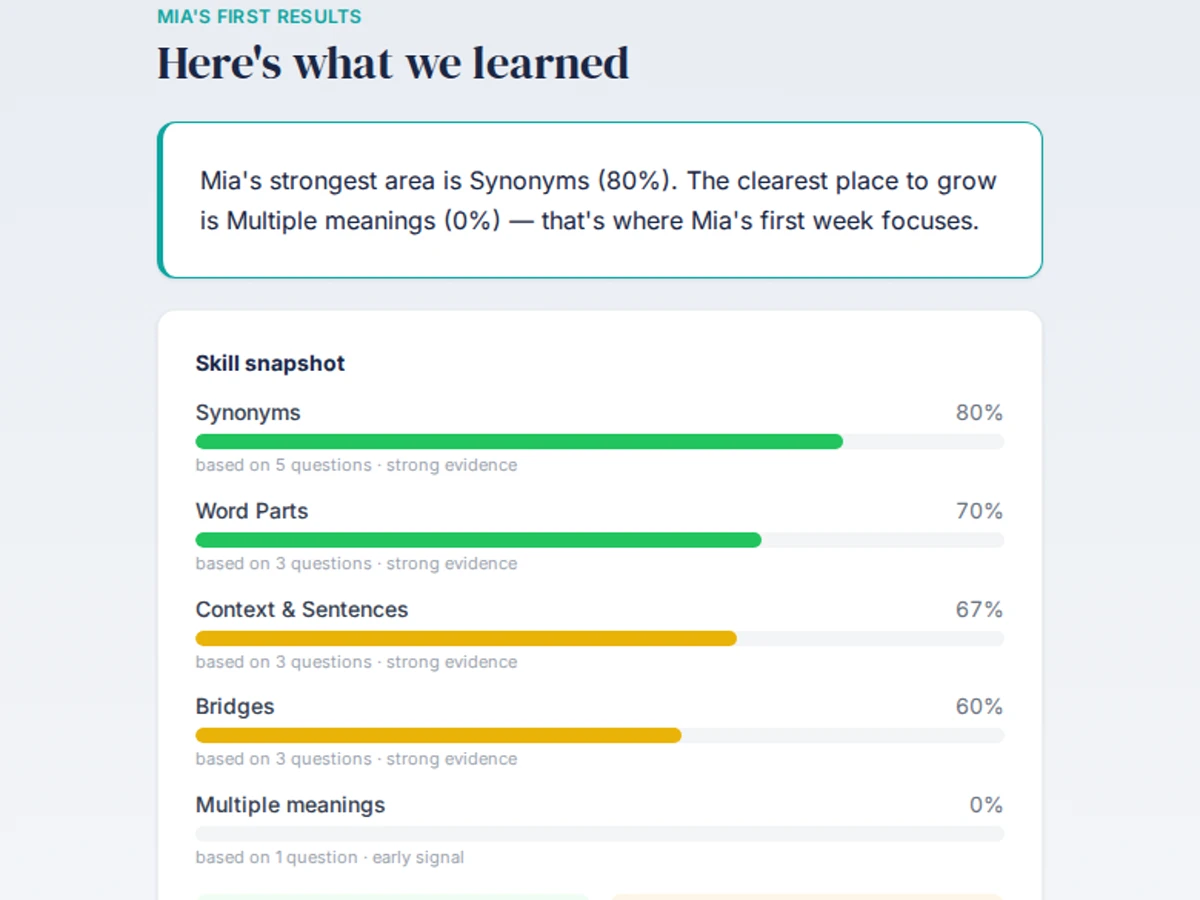
The check-up samples verbal skills and gives you an early strength, a growth area, and a first practice focus. It is not a full-length exam, an official SSAT or ISEE score, or an admissions prediction.
Your child has a CogAT scheduled — maybe next month, maybe in a few months — and you want to help. You have probably discovered that advice ranges from "just make sure they sleep well" to "buy every prep book on Amazon." Neither extreme is quite right.
Here is what actually works, organized by what you can do starting today, organized by your child's grade level. Everything in this guide is based on cognitive science, not test-prep industry convention.
The One Thing Most Parents Get Wrong
The most common mistake in CogAT verbal prep is confusing familiarity with learning. Parents drill their child with flashcards or practice questions repeatedly in the week before the test. The child recognizes the words during practice, which feels like learning. On test day, the words do not come back.
The problem is massed practice — studying the same material in concentrated bursts. Cognitive scientists call this the "fluency illusion": material reviewed multiple times in a row feels learned because recognition is easy, but retrieval under new conditions fails because the memory was never consolidated.
The research-backed alternative is spaced practice: shorter sessions spread over weeks, with enough time between sessions that your child has to work slightly to retrieve what they learned. This retrieval effort is what makes the memory stick.
For CogAT verbal, this translates to: 10 minutes a day for six to eight weeks beats two hours a day for three days before the test.
What the CogAT Verbal Battery Actually Tests
Before diving into strategies, it is worth being clear about what the verbal battery measures, because effective preparation has to target the right skills.
The CogAT verbal battery has three subtests:
Verbal Analogies test word-relationship reasoning: ocean:wave :: sky:? The student must identify that the first relationship is "large body contains this smaller thing" and apply that logic to find the answer (cloud). This requires knowing both words and understanding the relationship between them.
Verbal Classification tests category recognition: given three words that share a property, find the fourth word that belongs. robin, sparrow, wren — which of these also belongs? (eagle, salmon, hammer, seagull, carrot) Students need to correctly identify the precise category (small songbirds in this case) rather than a loose category (birds), since eagle is a bird but not a songbird.
Sentence Completion tests vocabulary breadth and context-clue reasoning: "The shy child was ____ at the party, staying close to the walls and barely speaking." Students use the context to identify a word meaning withdrawn or reluctant to engage socially.
All three subtests reward the same underlying skills: knowing words precisely, reasoning about word relationships, and reading context carefully. Everything in this guide targets those foundations.
By Grade Level: What to Focus On
Grades K-2: Build Oral Language First
At this stage, the most powerful CogAT verbal preparation is not test prep — it is language-rich parenting. For K-2 children, the verbal battery includes picture-based analogies and orally administered questions, so reading ability is not a limiting factor. What matters is the richness and range of language your child has encountered.
Read aloud every day. Not just leveled readers — interesting books, including books above your child's independent reading level. The vocabulary in books written for adults reading to children is substantially richer than what appears in books children read independently. Dr. Seuss is wonderful; Roald Dahl, E.B. White, and Mary Pope Osborne are better verbal prep.
Name things precisely. When you see a yellow flower, call it a daffodil instead of just "a flower." When your child is frustrated, use that word: "You look frustrated — is that right? Frustrated means you wanted something to happen and it is not happening." Precise naming builds the vocabulary specificity the classification subtest requires.
Talk about categories. At the grocery store, point out that apples and oranges are fruits while carrots and celery are vegetables. At the park, talk about which animals are birds, which are insects, which are mammals. Category thinking is the exact cognitive skill the verbal classification subtest measures.
Play "what's the connection?" with word pairs. Choose two related words from a book you are reading: castle:knight. Ask your child to explain the connection. Accept any reasonable answer and then offer the precise description: "You could also say that a knight lives in or guards a castle — it is a relationship between a person and the place they belong." This is analogy-readiness in disguise.
Grades 3-5: Start Root Words
By third grade, the CogAT is entirely word-based, and vocabulary range begins to matter substantially. This is the ideal time to begin explicit root word instruction.
Why root words? A student who learns the Latin root vis/vid (to see) gains immediate access to visible, vision, visualize, evidence, video, visor, visage, television. That is one root, eight words. There are roughly 30 roots that unlock the majority of academic vocabulary tested on the CogAT verbal battery. Learning 30 roots is a manageable six-to-eight-week project that pays dividends for years.
How to introduce roots: Start with high-frequency, easy-to-illustrate roots. Port means to carry: transport, export, import, portable, reporter. Have your child come up with examples and spot the root in new words they encounter while reading. Make it a game, not homework.
Practice analogy bridges: At this grade, start teaching your child to name the relationship between word pairs explicitly before guessing the answer in an analogy. Is puppy:dog a "young creature to adult" relationship or a "small creature to large creature" relationship? (It is both — which version is being tested depends on the answer choices.) Teaching precision about relationship types builds the relational reasoning these questions test.
Read above grade level: Students at this stage should be reading books that stretch their vocabulary. If your child is in fourth grade reading fourth-grade books, consider introducing one above-level book per month — something they find genuinely interesting in the next grade's reading range.
Grades 6-8: Systematic Vocabulary Study
At middle school grades, CogAT verbal questions use genuinely sophisticated vocabulary. The casual approach of "reading a lot" is still valuable but no longer sufficient on its own. Systematic vocabulary study becomes necessary.
Spaced repetition vocabulary practice: 15-20 minutes of vocabulary work per day, spread across the weeks before the test, produces the best retention. The key is returning to previously studied words at increasing intervals — not reviewing the same words in every session, but cycling back with enough gap that some forgetting has occurred. LexiMap's FSRS-based spaced repetition engine handles this automatically.
Roots and affixes: At this level, add prefixes and suffixes to the root-word study base. Common prefixes (un-, re-, pre-, dis-, mis-) and suffixes (-ous, -ful, -less, -tion, -ment) combine with roots to produce large, predictable word families. Benevolent breaks down as bene- (good) + vol/vole (to wish) + -ent (having the quality of) — "having the quality of wishing good." This analysis is immediately testable against the context and answer choices.
Mixed practice across all three subtests: At this level, your child should be practicing all three verbal subtest types in the same session, not isolating each type. The mental flexibility to shift between analogy reasoning (what is the relationship?), classification reasoning (what does this group have in common?), and sentence completion reasoning (what does this context suggest?) is a skill in itself.
One timed practice session per week: About four to six weeks before the test, add one timed practice session per week. The goal is not to build speed — the CogAT verbal battery has generous timing — but to develop comfort with working under any time constraints and to avoid the time-anxiety that some students experience even when time is not actually a problem.
Daily Practice Activities That Actually Work
You do not need to buy a prep course or hire a tutor to prepare your child meaningfully. Here are practical activities for different contexts:
The Car Ride Game
Ask your child one analogy question per car ride — no pressure, no keeping score. "What is the connection between scale and fish?" After they answer, compare your answers and discuss which relationship type it is. Move on. Over a week of school-drop-off commutes, that is five analogy questions, five reasoning discussions, and zero test-prep stress.
Dinner Table Word of the Week
Pick one interesting word per week and use it throughout the week in natural sentences. At the end of the week, ask your child to use the word in a sentence they make up. Track roots when relevant: this week's word is circumspect — circum- means "around" (like circumference) and spect means "to look" — so circumspect literally means "looking around (carefully) before acting."
The Odd One Out Game
Present four words — three that belong together and one that does not. Your child identifies the odd one out and, crucially, explains why the other three belong together. The explanations are where the learning happens. Easy version: apple, banana, carrot, grape. Harder: elated, ecstatic, overjoyed, content (three mean intensely happy; one means merely satisfied).
Context Clue Reading
Once a week, when reading together, pause before a word your child probably does not know and say, "What do you think that word means based on the sentence?" Work through the context clues together: "Look, the sentence says he was obstinate about not going — it also says 'even though everyone else wanted to go.' What word would fit there?" (stubborn, resistant, unyielding)
Managing Test-Day Logistics
Preparation is the long game. The week before the test, shift focus to logistics and well-being:
- Sleep is non-negotiable. Cognitive performance on reasoning tests is highly sensitive to sleep quality. A well-rested child with adequate preparation outperforms a tired child who studied more. Prioritize bedtime starting five to seven days before the test.
- No cramming the night before. The memory consolidation that makes learning stick happens during sleep. A child who studies vocabulary until 10 PM the night before a morning test may actually perform worse than one who stops at 7 PM and gets to bed by 8:30.
- Low-stakes framing. Tell your child: "This test is just showing what you already know. You have been practicing, and you are ready. Answer what you can, skip anything you are unsure about, and do your best." Do not communicate that a gifted program placement is riding on this single performance.
- Normal morning routine. Test mornings should be as normal as possible. A good breakfast — protein and complex carbohydrates — sustains attention better than a sugary alternative.
How Long Before the Test Should You Start?
The honest answer depends on your child's current vocabulary level and your starting date:
| Time Available | Recommended Approach |
|---|---|
| 12+ weeks | Full root-word program (30+ roots) + all three subtest formats + wide reading |
| 8-12 weeks | Core root-word study (15-20 roots) + subtest format practice + reading push |
| 4-8 weeks | Targeted vocabulary study + subtest format exposure + context clue practice |
| Under 4 weeks | Subtest format familiarity + vocabulary exposure + logistics/sleep focus |
| 1 week | Logistics only: sleep, format familiarity, low-stress framing |
If you have just learned your child has a CogAT coming up in a few days, the most useful thing you can do is ensure they know what the test looks like (format), they are sleeping well, and they feel confident rather than anxious. Cramming vocabulary in the final days provides minimal benefit and meaningful anxiety cost.
For families who have more lead time: start today. The earlier you begin building vocabulary through root study and spaced practice, the more durable and generalizable the gains.
One more thing worth naming clearly: root-word study is an efficient on-ramp, but it is not the whole picture. The CogAT rewards your child for relational reasoning (how well they recognize patterns and relationships between words), contextual inference (how well they read surrounding context to figure out meaning), and metacognitive habits (self-monitoring, strategy switching, pacing) — not just for vocabulary size. LexiMap trains all five verbal domains and makes each one visible on a parent dashboard, so the preparation your child does is matched to the full range of what the test actually measures.
Key Takeaways
- The single most common mistake is massed practice in the final days — 10 minutes of daily spaced practice over six to eight weeks produces far more durable retention than any last-minute push.
- Root-word study starting at grade 3 is a valuable on-ramp: 30 roots studied over six to eight weeks unlocks the majority of academic vocabulary tested across all three CogAT verbal subtests, and pairs best with relational reasoning and contextual inference practice.
- Everyday activities (car-ride analogy questions, dinner-table "Odd One Out," context-clue reading together) build the same reasoning skills the test measures without test-prep pressure.
- Sleep quality in the days before the test matters as much as preparation quality — prioritize bedtime starting five to seven days out, and avoid cramming the night before.
- Low-stakes framing protects performance: tell your child the test shows what they already know; preparation that creates anxiety is counterproductive on a working-memory task.
- With 12 or more weeks, pursue a full root-word program; with under four weeks, focus on format familiarity and sleep rather than vocabulary cramming.
For daily adaptive CogAT verbal practice designed around the research on vocabulary acquisition, visit our CogAT prep page. Short daily sessions, automatically spaced for retention.
Get SSAT/ISEE vocabulary resources by email
Related Articles
8 Ways a Strong Vocabulary Shapes Your Child's Future
Beyond test scores: the eight domains of adult life — from health and wealth to careers and emotional wellbeing — where research shows vocabulary makes a measurable difference.
Does Vocabulary Affect Test Scores? What the Research Actually Shows
A clear-eyed look at the evidence linking vocabulary to academic achievement, reading comprehension, and beyond — what's well-supported, what's overstated, and why it matters for test prep.
Entrance Exam Test Dates 2026-2027: Complete Calendar
Complete 2026-2027 test date calendar for SSAT, ISEE, HSPT, TACHS, COOP, and CogAT. Registration deadlines, testing windows, and score release dates in one place.
How Words Shape Your Child's Brain: The Neuroscience of Vocabulary
Vocabulary isn't just labels for things your child already understands — naming a concept changes how the brain processes it. The research on how words drive access, decisions, and even emotional regulation.
Related Guides
SSAT Vocabulary: The Complete Guide to Root-Based Learning
Master SSAT vocabulary through Latin and Greek roots. Learn how root-based learning, spaced repetition, and interactive practice build lasting verbal skills for grades 4-12.
SSAT Vocabulary List: 200+ Words Organized by Level and Root
Comprehensive SSAT vocabulary word lists organized by test level (Elementary, Middle, Upper) and root word family. Study the right words for your child's grade.
SSAT® is a registered trademark of The Enrollment Management Association. ISEE® is a registered trademark of the Educational Records Bureau (ERB). LexiMap is not affiliated with or endorsed by these organizations.