Best ISEE Vocabulary Apps and Tools: A 2026 Comparison
Find your child's ISEE vocabulary gaps
Start with a free, no-card ISEE check-up — 16–20 questions with a personalized parent report.
Find the ISEE vocabulary gaps — freeSee a sample parent report before starting
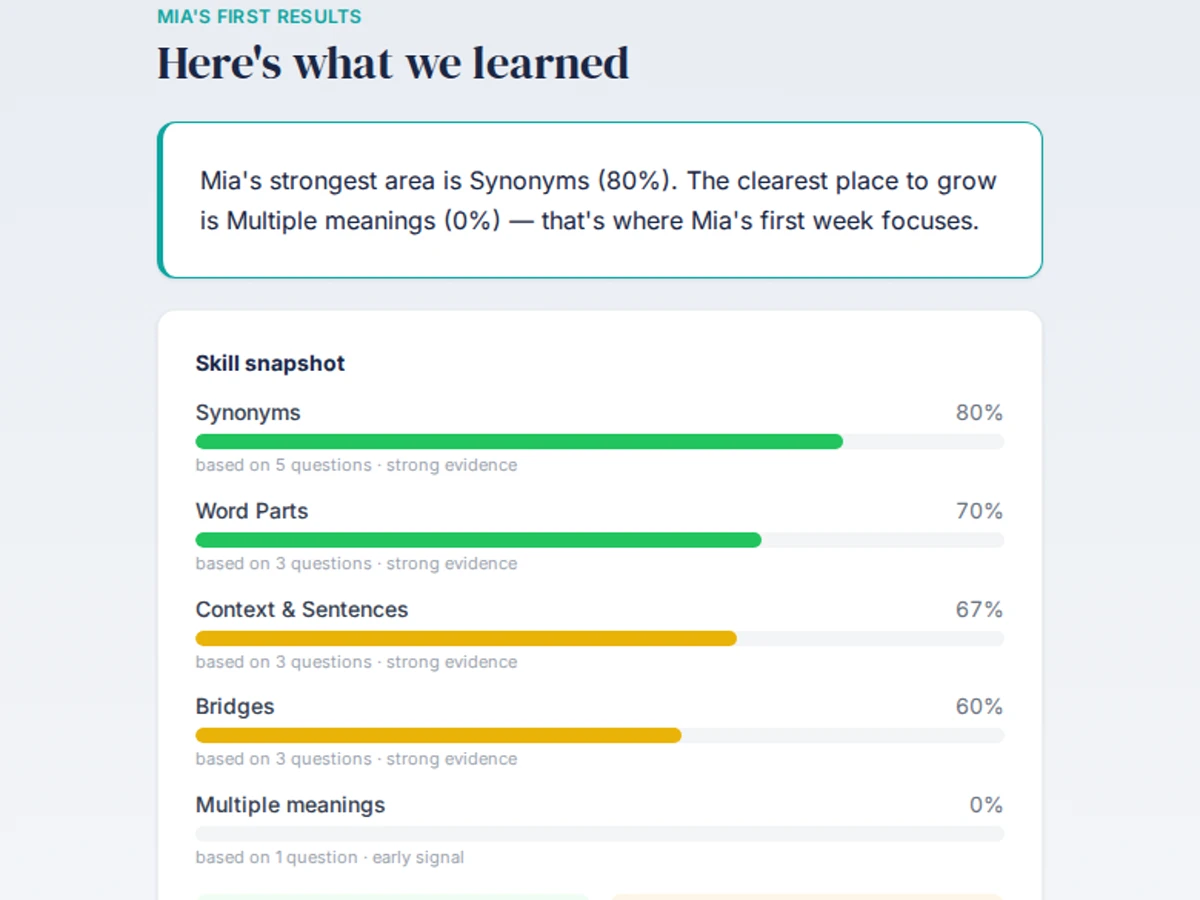
The check-up samples verbal skills and gives you an early strength, a growth area, and a first practice focus. It is not a full-length exam, an official SSAT or ISEE score, or an admissions prediction.
The ISEE verbal reasoning section rewards two things: deep vocabulary (synonyms) and the ability to work out meaning from context (sentence completions). Both are buildable, but different tools support them in different ways. This comparison covers the main options for ISEE-specific vocabulary preparation; for strategy rather than tools, see our ISEE verbal parent guide.
Last updated September 5, 2026
Disclosure: LexiMap publishes this comparison and is included as one of the options. Competitor descriptions and feature links were checked against public provider documentation on September 5, 2026, including Quizlet's study-mode documentation, its spaced-repetition feature page, the Anki manual, and Membean's personal plans. Features and pricing can change; we did not independently test every product or claim score outcomes.
What the ISEE Verbal Section Demands
The ISEE is administered at four levels; Primary has no verbal reasoning section. According to ERB's official family guide, the Lower Level verbal section runs 34 questions in 20 minutes, while Middle and Upper Levels run 40 questions in 20 minutes (checked September 5, 2026). That pace makes fast retrieval useful, and spaced repetition is one way to practice retrieval over time. Details and level-by-level strategy: ISEE verbal strategies by level.
The Tools
- LexiMap — root-based curriculum with FSRS spaced repetition, dedicated sentence-completion and context-clue practice modes, short game-based sessions, and a parent dashboard. Its five-domain learning model is a product framework, not the ISEE's official scoring taxonomy. ISEE vocabulary/verbal scope only — not reading comprehension, math, or essay. Details: ISEE vocabulary prep.
- Quizlet / Anki — flexible flashcards; useful for a student who already has strong word knowledge and wants self-made review. Quizlet documents spaced-repetition study features, while Anki's scheduling requires setup and discipline; neither supplies LexiMap's built-in ISEE curriculum. See LexiMap vs. Quizlet.
- General vocabulary platforms (Vocabulary.com, Membean) — broad academic vocabulary; families should verify ISEE alignment and sentence-completion coverage. Membean offers personal and homeschool plans alongside school use. See LexiMap vs. Membean.
- Practice-test platforms — useful for format familiarity and pacing in the final weeks, but they serve a different job from vocabulary instruction. Pair them when appropriate.
A Simple Decision Rule
Plan backward from test day. Give the learner repeated opportunities to review roots, apply words in context, and practice the ISEE question format. As test day approaches, add timed sentence-completion sets and full verbal sections when appropriate, using errors to choose what to review. The right sequence and amount of practice depend on the learner's starting point and available time.
Key Takeaways
- ISEE verbal = synonyms + sentence completions; prep tools must train decoding and context-clue skill.
- Root-based study with spaced repetition is one useful foundation; flashcards and practice tests have different jobs and may need to be combined with context practice.
- Match tool difficulty to your child's ISEE level, and let a parent dashboard tell you whether practice is converting into retention.
Questions parents ask
What is the best ISEE vocabulary app?
The best tool for your child depends on their starting point. Compare root-based instruction, spaced-repetition options, ISEE alignment including sentence-completion practice, engagement your child will sustain daily, and parent-visible progress. Purpose-built tools like LexiMap combine these features; flashcard tools may require the family to add or curate some of them.
How is ISEE vocabulary prep different from SSAT prep?
The word pool overlaps heavily, but the ISEE tests synonyms plus sentence completions (no analogies), so context-clue practice matters more. Root study transfers between the two tests; the format layer is what changes.
Is a free flashcard app enough for the ISEE?
Usually only as a supplement. A free or user-created deck isn't necessarily curated to ISEE vocabulary, and the review experience depends on the product, study mode, and account. Quizlet and Anki document scheduling features, but setup and access vary. Pair flashcards with context and sentence-completion practice so your child works with the ISEE's question formats.
Get SSAT/ISEE vocabulary resources by email
Related Articles
Best SSAT Vocabulary Apps and Tools: A 2026 Comparison
Compare the best SSAT vocabulary prep tools — LexiMap, Quizlet, Anki, practice tests, and vocabulary apps. See which approach actually builds lasting verbal skills.
Best Vocabulary Apps for Private-School Admissions Tests (2026)
Compare vocabulary prep apps for private-school entrance exams — SSAT, ISEE, HSPT, and more. What to look for, honest tool comparisons, and how to choose for your child.
LexiMap vs. Membean for SSAT and ISEE Vocabulary Prep
Compare LexiMap and Membean for grades 6–12 vocabulary learning and focused SSAT/ISEE verbal practice, including personal-plan access and where each tool fits.
LexiMap vs. Test Innovators: SSAT Vocabulary Prep Compared
Side-by-side comparison of LexiMap and Test Innovators for SSAT vocabulary preparation. See how root-based learning with spaced repetition compares to traditional practice tests.
Related Guides
The Parent's Complete Guide to SSAT & ISEE Prep
Everything parents need to know about SSAT and ISEE preparation. Test formats, timelines, study strategies, score interpretation, and how to support your child's verbal growth.
SSAT Vocabulary: The Complete Guide to Root-Based Learning
Master SSAT vocabulary through Latin and Greek roots. Learn how root-based learning, spaced repetition, and interactive practice build lasting verbal skills for grades 4-12.
SSAT® is a registered trademark of The Enrollment Management Association. ISEE® is a registered trademark of the Educational Records Bureau (ERB). LexiMap is not affiliated with or endorsed by these organizations.